


Jayla Cole never experienced what most would consider the carefree teenage years. She could not get a driver’s license because of epilepsy and frequent seizures. She didn’t want to take photos or selfies because Bell’s Palsy left her with permanent facial paralysis – a twisted smile that led to bullying by classmates.
Her father, who was a heavy drinker, brought additional trauma. He dipped in and out of her life when it was convenient, while introducing her to other children he’d fathered along the way. Papa was a rolling stone, but he rarely rolled to her when she needed him most. When he did, the drunken interactions were often toxic and painful.
“I was very depressed in my teenage years, and I just did not want to be alive,” Cole told me. “I was always depressed in high school. I was always sad in high school. I never got the help I needed in high school.
“When I got to college, I realized that you don’t want to hold on to those things, hold on to the trauma,” she said. “If you don’t get help now, when will you?”
It’s the message Active Minds is pushing for young Americans to hear. The organization, a Washington, D.C.-based nonprofit, works to empower youth and young adults to erase the stigmas surrounding mental health.
Cole, 20, a sophomore, is a nursing major at the University of Tennessee at Martin. She’s now in therapy, and participating in campus activities that promote mental wellness. She says she’s grown from the scared freshman who last year had her mother and step-father come pick her up from school every weekend.

Jayla Cole, 20, is a sophomore and nursing major at the University of Tennessee at Martin. Cole struggled with mental health wellness in high school but has sought therapy and peer support on campus.
But she knows many of her peers don’t get that help. They continue to suffer in silence.
She was captivated recently, listening to a complete stranger share his story of that same suffering. He came to campus to speak as an ambassador for Active Minds. She didn’t really know what to expect, but she has been steadfast in her desire and need to be mentally healthy. So she had decided to go, after spotting a flyer in the student union.
And each word she heard hit her like a ton of illuminating bricks.
So much so that after the discussion, Cole shyly approached the stranger. She began to cry, explaining how she was raised in a household where mental health was never a priority. But there is power in vulnerability, and she felt safe to share her experiences.
“A lot of college students have mental health issues,” Cole told me. “Most people on campus are struggling with depression, anxiety and more. And they don’t know how to talk to their family and friends about it.”
A growing movement for mental health
You are not alone in this.
Mental health is just as important as physical health.
Depression, anxiety and panic attacks are not a sign of weakness. They are signs of trying to be too strong for too long.
Self care is paramount.
Seeking help is a sign of strength; not something to be ashamed of.
Childhood trauma should not be ignored.
These are life lessons of Active Minds, which continues to grow on high school and college campuses nationwide.
It’s needed.
Cole, who recently attended her first Active Minds session on campus, said she was concerned to hear from so many of her peers who also struggle with mental health issues, but also comforted to know they, too, are seeking help, understanding and refuge among peers.

Jay Michael Martin Jr., an ambassador for mental health at Active Minds, speaks during an event with the Vanderbilt Active Minds group at Vanderbilt University in Nashville on Feb. 4, 2026.
It’s called the student-to-student model. There’s nothing fancy about it. The student groups typically meet monthly on campus to celebrate wins and to talk through challenges. They create phone trees for students who may be in crisis.
Declining mental health among teens and young adults has become a growing crisis. According to the National Institute of Mental Health, young adults in the 18-25 age group have the highest rates of mental illness among all adults, at 36%.
The reasons are complex. There are lingering consequences from the Covid-19 pandemic. The abrupt onset of social isolation and the disruption of academic routine led to anxiety. But poverty, food and housing insecurity, homophobia, substance abuse, gun violence, being a member of a minority community and social media overload have also served as a catalyst to emotional exhaustion, according to a 2023 report published in the Community Mental Health Journal.
And oftentimes, parents don’t even know. A 2024 National Health Statistics Report found that while 93% of parents believed their teenager always or usually received adequate emotional support — only 58.5% of teens said the same.
No one was talking about mental health
Active Minds has roughly 600 active chapters on many of our nation’s campuses, including Northwestern University, Columbia University, the University of Delaware, Baylor University, UCLA, College of William and Mary, University of Michigan, Georgetown University, Harvard University, and Penn State University along with hundreds of high schools.
The organization was founded by Alison Malmon in 2000, when she was a junior at the University of Pennsylvania following the suicide of her brother and only sibling, Brian Malmon. Brian, also a college student, had mental illness and had been suffering in silence.

Jay Michael Martin Jr., an ambassador for mental health at Active Minds, speaks during an event with the Vanderbilt Active Minds group at Vanderbilt University in Nashville on Feb. 4, 2026.
Alison Malmon realized from the depths of grief that no one was talking about mental health. So she started talking about it. The only silence she wanted was that of the stigmas that kept so many quiet. Her work spread to other campuses. Active Minds was incorporated as a nonprofit organization in 2003.
On Feb. 4, Active Minds announced a $15 million increase for the 988 Lifeline and a $4 million increase for the Garrett Lee Smith (GLS) Youth Suicide Prevention program.
The organization helps empower students to lobby college administrators for their needs, including expanding mental health services and improving messages to counter the lasting stigmas of seeking help. Then it’s up to the students to serve as peer support for one another – on those days when finals are stressing them out, personal relationships are challenging or when someone simply needs a listening ear.
Studies have shown that young people may be more likely to seek help from social networks such as peers.
On Vanderbilt University’s campus, Abhiram Chilakamarri serves as president of the Active Minds chapter. Students sometimes float in and out, but there’s a strong foundation of about 100 people who are active. The group has worked to have those voices trickle into classrooms and dorm rooms.

Vanderbilt University student Abhiram Chilakamarri, 21, serves as the president of the Active Minds chapter on campus. He became interested in mental health awareness after losing a dear friend to suicide while in high school.
One important Active Minds push for change that was enacted last academic year: Vanderbilt professors now include mental health resources and other language on class syllabi that inform students they have support among faculty members, too.
“The brand is so amazing – we’re able to tell our stories, our fears,” said Chilakamarri, a premed junior who lost a dear friend to suicide while in high school in the Atlanta area. “I’ve been very grateful to see people open up, to hear these stories and to see the impact we can have when we decide ‘you can talk to your friends about this.’”
Active Minds ambassadors also travel to campuses as keynote speakers to lead panel discussions, suicide prevention walks, wellness runs and advice on how to start or grow chapters. It’s a simple way to help connect students with one another in a safe space. Ambassadors – roughly 15 are on the current roster – tend to be musicians, athletes, actors, social media influencers and artists. They’re often selected because they have an established history of using their various platforms to promote mental wellness.
And, sometimes, they cook.
‘Cooking became my therapy’
Jay Michael Martin Jr., a national PBS host and storyteller has been named as the newest Active Minds national mental health ambassador. He knows how to connect with the students he’ll encounter as he travels from state to state, including a recent trip to Jayla Cole’s school in Tennessee, because he’s had his own struggles.
He found refuge in the kitchen.
Martin, 42, a Seattle resident, grew up with addiction. His mother, who passed away from a fentanyl overdose in 2024, struggled to raise him and his six siblings, but she taught him to cook. It was the love she could give, and the one he still carries.

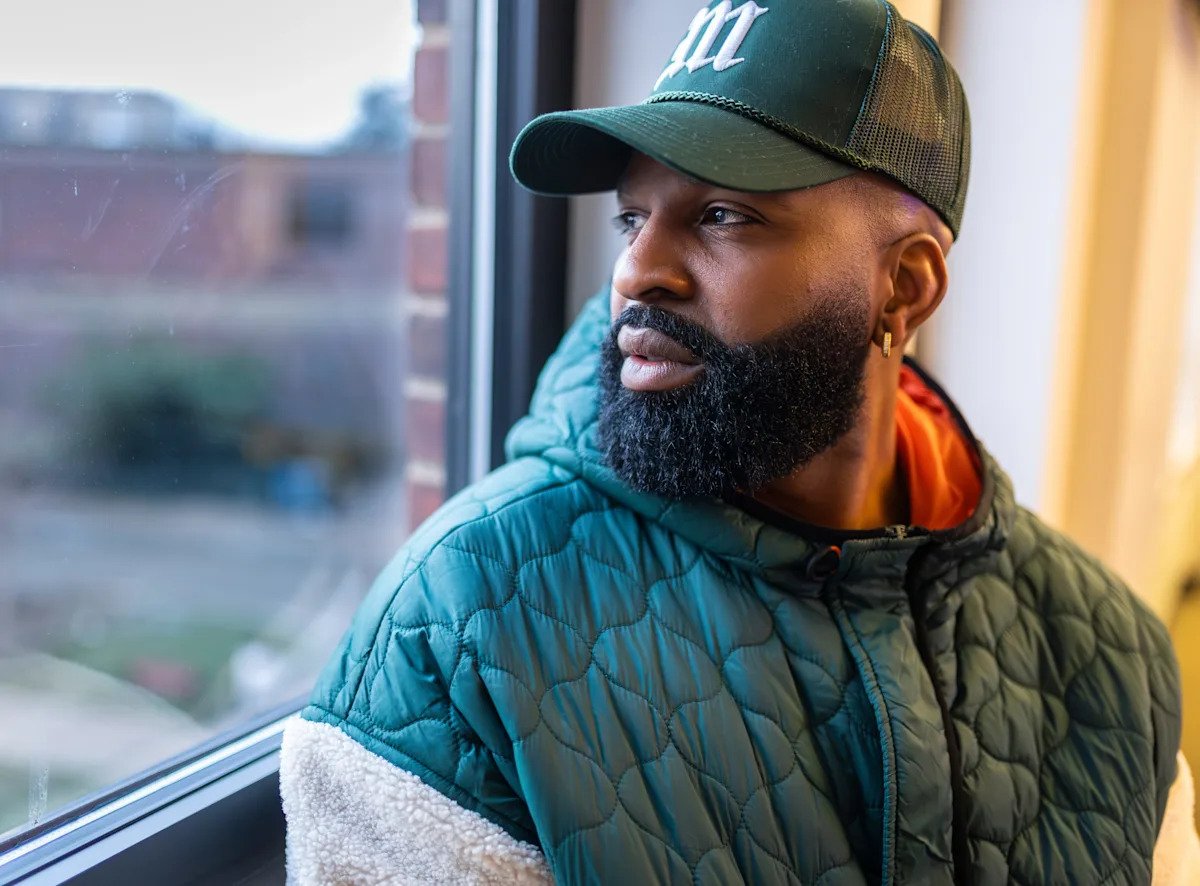
Portrait photo of Jay Michael Martin Jr., an ambassador for mental health at Active Minds, taken before an event he spoke at with the Vanderbilt Active Minds group at Vanderbilt University in Nashville on Feb. 4, 2026.
Martin recalls around age 11 coming home from school, finding his mother in the kitchen talking to herself while running water from the sink overflowed everywhere. “I remember helping her,” Martin said, “But I didn’t know what that was. I didn’t know what was happening.”
At 15, Martin remembers his mother drinking heavily and asking him to crush pills for her outside of a grocery store. To this day he doesn’t know what she was taking. But the alcohol and pill cocktail would make her fade in and out – sometimes even while driving.
“I didn’t think less of her because I wanted to protect her,” Martin told me. “And when we were in the kitchen together, it was magic.”
He watched as his mother’s life fell apart: from living in a big house and being the first lady at a local church, to living in an apartment, and finally a trailer park.
Charmaine Lynn Martin, a perfectly imperfect mother, died at age 59.
“I am not a professional therapist,” Martin told me. “But I have life experiences. And I want to empower others to get the help they need. I want people to walk away with a little hope about the possibilities of a healthy and fulfilling life.”
Though childhood was rough, Martin’s mother always told him: “Flavors and seasonings are like people. If you mix them just right, and when they blend well, you bring out something special.”
Perfectly imperfect. A little dash of this; a little sprinkle of that.
“Cooking became my therapy long before I ever thought to use the word ‘therapy,’” Martin told me. “As life got harder through grief, loss and depression – the kitchen remained a steady place for me. It took me a while to even realize it. But food has always been a way to bring people together. If I can show you love and respect by cooking for you and feeding you, then I feel like I can talk to you emotionally.”
So Martin goes and talks to these vulnerable students. He sometimes cooks “Jay’s chopped sandwiches” for them. He shares his testimony. Because if you’re not giving, you’re not living. Sure, he could be angry about how his mother let him down, how he had to navigate a life as the oldest sibling without much guidance.
He’s chosen freedom. Freedom to shed the weight of familial addiction and spiritual abuse.
Martin is a husband and a father of three, including a son who is in college. Still, it took an emotional breakdown in 2017 for him to recognize he needed to start dealing with his own childhood traumas. Because he didn’t want that reality for his own children, or for the generations of young adults he would ultimately mentor.
He sees the struggle. He knows the struggle. He wants to help.
“I’m giving them what I wish someone had given me,” Martin said. “There’s a message: It’s OK not to be OK. There’s something beautiful about brokenness and when you start to heal.”
Suzette Hackney is a national columnist. Reach her on X:@suzyscribe
This article originally appeared on USA TODAY: Active Minds takes on the mental-health crisis, student-to-student
