


Tens of thousands of those injured in Gaza during the Israel-Hamas war require reconstructive surgery immediately and in years to come, a new study published Thursday finds.
Researchers from Duke University, Guy’s and St. Thomas’ NHS Foundation Trust in London and Al Shifa Hospital in Gaza found that about 116,000 injuries in Gaza have been sustained between Oct. 7, 2023, and May 1, 2025.
Of those injuries, they estimate up to 46,000 require reconstructive surgery. The team said it expects this figure to increase to up to 68,000 by May 2026 if hostilities don’t abate or cease, according to the study, published in the journal eClinicalMedicine.
‘They’re losing hope’: What doctors, aid workers are seeing in Gaza amid hunger crisis
The team believes this is the first model predicting the injury burden in Gaza and forecasting how it could increase, using granular multi-source data.
“This is a very high number, and these injuries are quite demanding and require specialized care that is not available in Gaza,” Dr. Zaher Sahloul, co-founder of the humanitarian organization MedGlobal, who was not involved with the study, told ABC News.
“So, if these numbers are accurate based on the model, then this is a huge burden to the health care system, not in Gaza because there’s no facilities in Gaza that can accommodate that,” he continued. “There is no specialist, or reconstructive surgeons or plastic surgeons even left. So, it will be a burden on the neighboring countries.”

Bashar Taleb/AFP via Getty Images – PHOTO: Wounded Palestinians get ready to leave the Gaza Strip for treatment abroad in Khan Yunis, in the southern Gaza Strip on February 3, 2026.
Since the war began on Oct. 7, 2023 — when Hamas launched a surprise terrorist attack in Israel that killed roughly 1,200 Israelis, and Israel responded by declaring war — it has created a massive injury burden for the Palestinian civilian population, according to the authors.
However, they note that collecting accurate data is challenging in conflict zones due to the destruction of health care facilities, the deaths of health care workers and blockade restrictions on information.
Humanitarian workers previously told ABC News that the health care system in Gaza has collapsed, reducing the capacity to provide reconstructive care. They added that roads have been destroyed — making some areas hard to access — and rubble may be hiding unexploded ordnance, making some travel to collect data or provide care dangerous.
“It’s very difficult to have an accurate estimate because of the displacement, because of a lack of data, because of a lack of hospitals that can document the patient’s needs in terms of surgery,” Sahloul said. “The major hospitals that used to do reconstructive surgery in Gaza … also were depleted of the equipment and the specialists who are able to do that.”
The authors wrote in the study that addressing the growing gap between the need for reconstructive surgery because of the conflict and the health care system capacity “requires a consensus on the volume and pattern of injuries, and the ability to forecast future injuries.”
UNRWA chief says Gaza has become ‘graveyard of children’ as medicine, fuel shortages threaten hospitals
The team built a model using attack data, geospatial mapping and population density estimates from humanitarian, governmental and media sources. The model estimates the number of injuries that have occurred and forecasts, through May 2026, the number of injuries that could occur.
The model found that, as of May 2025, between 29,000 and 46,000 injuries have occurred requiring reconstructive surgery, including complex soft tissue wound management, which involves cleaning and dressing wounds as well as reducing pain and inflammation.
Reconstructive surgery also involves salvaging limbs, burn reconstruction and craniofacial reconstruction, meaning repairing injuries to the skull, face and jaw.
Sahloul, who was in Gaza in early 2024 working in the southern cities of Khan Younis and Rafah, said he and his colleagues saw a high number of crush injuries — which is when excessive force or pressure is put on a body part — after mass casualty events.
“Most of these patients are left untreated in terms of proper wound treatment and reconstructive surgery because of the lack of availability of surgeons,” he said. “And then the war got even worse after I left … so I wouldn’t be surprised that this number is accurate, although it’s very difficult to accurately predict the number of patients.”

Bashar Taleb/AFP via Getty Images – PHOTO: World Health Organisation officials help with the evacuation of Palestinian patients and war-wounded people in Khan Yunis, in the southern Gaza Strip on February 3, 2026.
The model found that about 80% of injuries requiring reconstructive surgery likely occurred as a result of explosions from air or drone strikes and shelling attacks. These were largely in urban settings, both before and after those areas were destroyed by heavy bombardment, the authors said.
Additionally, the model found that through May 2026, the range of injuries requiring reconstructive surgery could increase to between 34,000 and 68,000.
“Without a significant increase in reconstructive capacity in the region through a combination of aid, training programs, and rebuilding of health care infrastructure, tens of thousands of patients will remain with surgically addressable disability,” the authors wrote.
Inside Gaza’s mental health crisis impacting civilians, aid workers: ‘Catastrophic’
Shaloul has said at least 1,500 people have been killed since the ceasefire was announced in October 2025, according to the Hamas-run Gaza Ministry of Health, so it wouldn’t be surprising to see the number of those seriously injured increase.
“These are astronomical numbers and, if they’re accurate, it’s a huge burden on the health care system in the region,” Shaloul said. “Most of these patients will have complications, unfortunately, and infection and die while waiting for surgery because I don’t believe that they will be evacuated.”

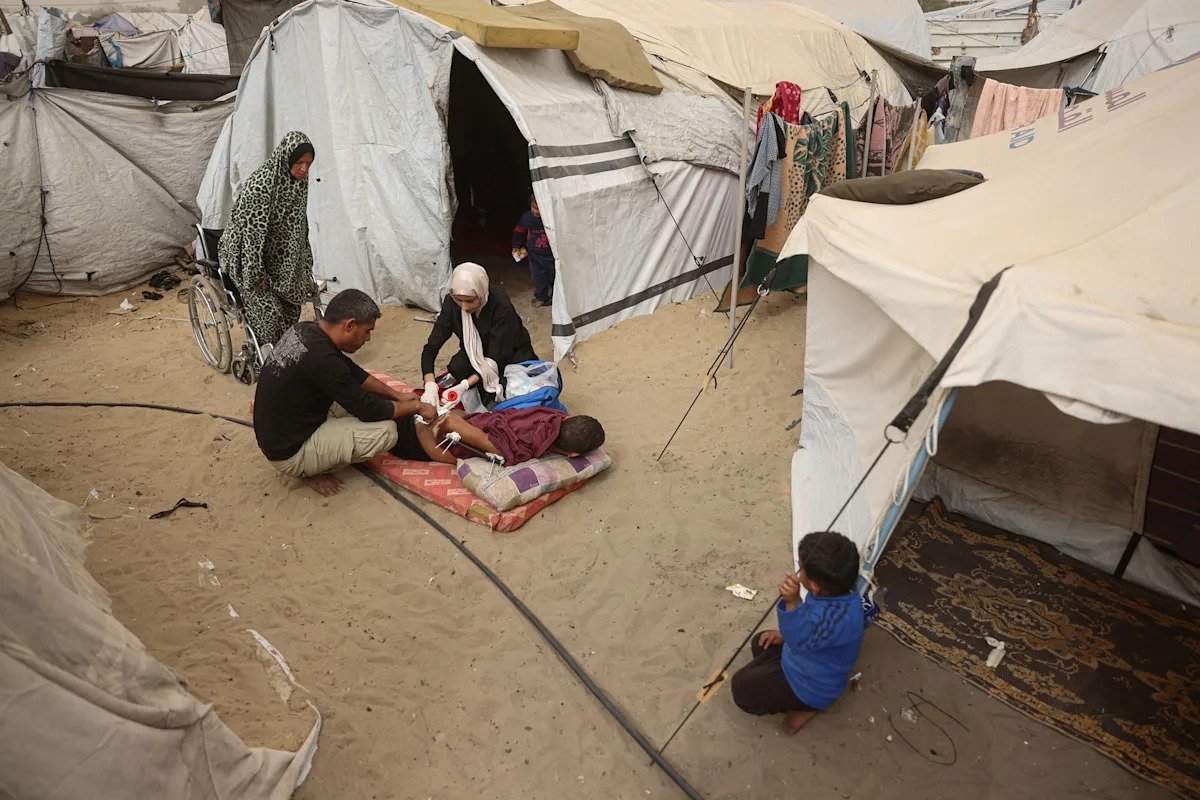
Bashar Taleb/AFP via Getty Images – PHOTO: Displaced Palestinian nurse, 23-year-old Dalia Taha Abu Zarifa, attends to a patient who is seriously ill and who cannot make daily visits to a hospital, in the Al-Mawasi area of Khan Yunis in the southern Gaza Strip on February 14, 2026.
The Israeli government and the Israel Defense Forces (IDF) have previously claimed that Hamas has been responsible for violence, including mass casualty events near food aid distribution sites.
The IDF has claimed Hamas shoots civilians waiting in food lines and films the events for propaganda videos. Hamas has denied these claims.
The IDF did not immediately return ABC News’ request for comment on the study’s findings.
“These [injury] numbers, regardless of whether they are 20,000 or 36,000, are a huge number for even an advanced country with advanced health care systems,” Shaloul said. “The second thing is that it’s important for neighboring countries and the countries that have advanced medical systems that are able to treat these patients to accelerate the process of evacuation, and it’s also important for the Israeli authority to expedite the process for the evacuation.”
