


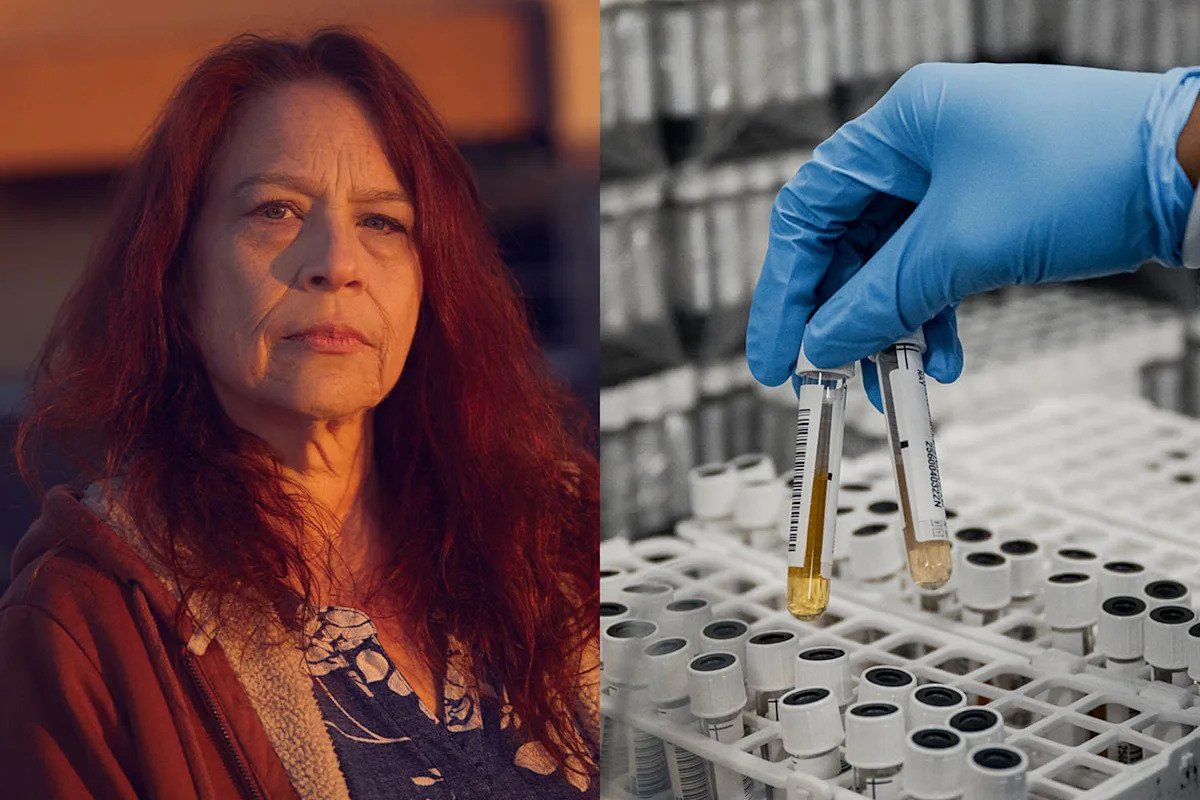
Inside a suburban Philadelphia strip mall, between the Hair Cuttery and a Citizens Bank, a dozen people lay on black ergonomic beds a few feet apart, hooked up through a needle in the crook of their arms to machines pumping blood out of their veins. They were there to sell their plasma in exchange for $65 on a prepaid debit card.
Ian Pleasant, 43, had come that morning to get some extra money for toilet paper and pet food.
“I’m making enough money now doing DoorDash to keep up with the bills, but for anything else in the house, this is going to help out,” he said, as he waited for an employee at the B Positive plasma center in Holmes, Pennsylvania, to insert a thick needle into his arm.
About an hour later, the employee came back to collect a container of his straw-colored plasma that would be tested, frozen and turned into medicines sold for a profit to patients around the world.
For more on this story, watch “Hallie Jackson NOW” on NBC News NOW today at 5 p.m. ET
It’s a scene repeated by an estimated 200,000 people a day across the country as part of a multibillion-dollar business fueled by a growing number of Americans willing to trade their blood for money in an economy where many have seen their job prospects weaken, costs rise and savings dwindle. Despite data that shows a relatively stable economy, middle-class Americans say they have had to start selling their plasma over the past year to cover basic expenses, from medical bills to a winter coat for their child.
“I’m angry that I’m working this much, that I’m educated, that I’m articulate, that I have marketable skills, and that I’m reduced to selling my plasma,” said Jill Chamberlain, in Phoenix, who has gone from making $87,000 a year to $16.11 an hour after being laid off from her job overseeing the finances of a local business in 2024. “I was ashamed at first, but now I’m angry. This is not how things are supposed to be.”

Jill Chamberlain says she works up to 80 hours a week but still isn’t able to cover her bills without money from plasma. (Jesse Rieser for NBC News)
(Jesse Rieser for NBC News)
Do you have a story to share about how you’re getting by in this economy? Email reporter Shannon Pettypiece
Last year, people in the U.S. made an estimated $4.7 billion selling about 62.5 million liters of their plasma, a more than 30% increase in the amount of plasma collected since 2022, according to Peter Jaworski, a professor at Georgetown University who studies the ethics and economics of the plasma business.
The transactions occur in more than 1,200 plasma centers — there are now more places to sell plasma than there are Costco stores — and more are popping up in solidly middle-class neighborhoods, including suburban strip malls and college towns, Jaworski said. As America’s economic divide widens, with the top 1% of households owning more than 30% of the country’s wealth, the payments people receive for selling plasma are playing a quiet role in keeping households above water financially.
Margo Thompson and her husband make around $120,000 a year in a rural corner of Idaho, but the couple started selling their plasma about a year ago to cover their car payment and one-time expenses, like new tires and medical bills. In Oklahoma City, Larry Jones, 64, started selling his plasma in April after his rent increased to $800 a month, taking a significant chunk out of the $1,800 a month in take-home pay he gets as a school bus monitor for children with disabilities. Erin Ragnetti started selling plasma in the past year to pay off debt and bills not covered by her cleaning jobs and her husband’s salary at a heating and cooling company in Fresno, California.
“Because the economy is what it is right now, everything’s just so much more expensive,” Ragnetti said. “I realized, if we’re going to make ends meet, I’ve got to find a way to make more money.”

Ian Pleasant began selling his plasma to pay for his rent after breaking his leg. (Hannah Yoon for NBC News)
(Hannah Yoon for NBC News)
Researchers have found that when a new plasma center opens in a neighborhood, foot traffic at local grocery stores increases, interest in payday loans declines and crime goes down, an indication of the way money from plasma props up households’ finances for necessities.
It’s a uniquely American economic phenomenon. Only a handful of countries allow people to be paid for their plasma, and no other country lets people donate as frequently as the U.S. does — up to twice a week, though there is limited data on the long-term health effects, and some people report dizziness, bruising and exhaustion after the process. People lose 10% of their blood volume when they donate; a healthy person should be able to regenerate that within hours to days.
The looser rules in the U.S. have turned plasma into a significant export: America supplies 70% of the world’s plasma, shipping $6.2 billion worth overseas in 2024.
“The U.S. has created a very attractive market for plasma centers,” said Emily Gallagher, a business professor at University of Colorado Boulder who has studied the economic impact of plasma collection. “Not only does it allow for paid donation of up to twice a week, but we also have a country where there’s a lot of poverty and a social system that doesn’t help that much.”
In the suburbs of Minneapolis, Michelle Eagan drops her son off at preschool then drives 35 minutes across town twice a week to sell her plasma to help cover his $700-a-month tuition.
“It’s a nice preschool. Sometimes I do think, ‘I bet there are no other parents here that are donating plasma to pay for this preschool,’” said Eagan, who has made around $400 a month from her plasma since September.

Michelle Eagan sells her plasma as often as twice a week to cover her son’s preschool bills. (Ackerman + Gruber for NBC News)
(Ackerman + Gruber for NBC News)
The money has become a necessity for Eagan’s family after she left her job making $75,000 a year as a paralegal for UnitedHealth Group to care for her son full time. Even living in a relatively affordable part of Minneapolis, her husband’s $90,000 salary as a business manager hasn’t been enough for the family of three to get by, and their credit card balances have been steadily rising.
Eagan sells her plasma to BioLife, which is a part of the Japanese drugmaker Takeda; many plasma centers are run by a handful of biopharmaceutical companies that turn the fluid into medicine. BioLife, like others, uses incentives to keep her coming. For instance, her first payment of the week is $45, but if she goes back a second time that week, she gets $65. In November, the company ran a “Sweater Weather” promotion where clients who sold their plasma eight times that month would get entered into a raffle to win $1,000. In December, BioLife offered reward points for people who donated seven times in a month or for three consecutive months that they could redeem for gift cards.
“It’s like a drug dealer — once they have you in there, they have to keep you coming back,” Eagan said. “But they’re not a charity. They can get people to come in there for that amount of money, if it’s worth your time, and clearly it’s worth my time.”

Michelle Eagan helps her son brush his teeth before preschool. (Ackerman + Gruber for NBC News)
(Ackerman + Gruber for NBC News)
BioLife declined to comment on how it determines its compensation structure. The company, like others, said that it isn’t paying individuals for their plasma, which the company says they are donating, but rather compensating them for their time. (People are generally only paid, though, if they give their plasma; they aren’t paid if they try to donate but are turned away, for example if they are dehydrated or have low protein levels.)
“People choose to donate plasma for a variety of reasons. Whether for personal motivations, a desire to give back, or to receive compensation for their time and commitment, we recognize and appreciate everyone who graciously donates plasma,” BioLife said in a statement. “In line with industry practice, BioLife compensates plasma donors in recognition for their time and effort. The level of compensation may vary depending on center location and if someone is an existing or new donor.”
Turning plasma from an individual donor into a treatment for a patient can be a complex process that takes up to a year. The plasma is tested for viruses and then goes through a purification and manufacturing process, where the proteins and antibodies are extracted. It can take plasma from more than 100 people to support one patient each year, according to the Plasma Protein Therapeutics Association.
Plasma industry officials said they see their business as a win-win: Patients get the plasma they need to treat potentially fatal conditions, like hemophilia, burns and rare immune disorders, and those selling their plasma get extra money to help out with their household expenses.

An apheresis machine collects blood from donors and separates out the plasma before returning the remaining blood to the donors’ bodies. (Hannah Yoon for NBC News)
(Hannah Yoon for NBC News)
“We hope that when people consider donating plasma, it is not only something that you would consider at a time of need, but something that you might make part of your altruistic endeavors,” Anita Brikman, head of the Plasma Protein Therapeutics Association, said. “People think about blood donation that way, and we hope that more people would think about plasma donation.”
While there are altruistic reasons for giving plasma, without the financial incentive, there wouldn’t be enough supply to meet the demand for plasma-based treatments, Jaworski, the plasma researcher, said. Countries that don’t allow payment for plasma, such as Canada and the U.K., don’t have enough plasma-based therapies available to treat patients, making them dependent on plasma from the U.S., he said.
“The model of not compensating people just doesn’t lead to enough plasma,” Jaworski said. “In the United States, we don’t pay people to donate blood, but we have enough blood. However, when it comes to plasma, we need much more participation, and we need people to donate much more often.” (Donating blood can be faster than donating plasma, which takes about an hour, as a machine filters the plasma from the donor’s blood and returns what remains back into the donor’s body.)

Michelle Eagan drops her son off at preschool. (Ackerman + Gruber for NBC News)
(Ackerman + Gruber for NBC News)
Plasma sellers interviewed by NBC News said the benefit to patients was an added bonus, but it was the money that drew them in and kept them coming back.
“They are all about how you’re helping to save lives. But honestly, no one’s there for that,” Eagan said.
At the B Positive plasma center near Philadelphia, workers bounce among a steady flow of patients, inserting needles, removing tubes and canisters still coated in blood, and ferrying plasma into a walk-in freezer before it’s shipped to pharmaceutical companies to be turned into medicines.
Ben Ruder, the company’s CEO, said the business operates on relatively narrow margins, similar to those of a restaurant, and is vulnerable to spikes in the cost of supplies and labor. The expenses add up: hiring staff, buying equipment and medical supplies, testing the plasma, and meeting all the regulatory requirements of a plasma center.
“You’re spending significant amounts of money to open a center, which then you obviously have to recoup,” Ruder said. “The incentive is commensurate with maintaining a healthy margin, just like any business would.”

Ben Ruder, CEO of B Positive National Blood Services. (Hannah Yoon for NBC News)
(Hannah Yoon for NBC News)
Donors say that the amount companies pay varies throughout the year, apparently as demand ebbs and flows. Payments tend to go down in December, for instance, when there is an uptick in people wanting to make extra money around the holidays. When tax refunds start hitting bank accounts at the start of the year, the number of sellers tends to go down, so the payments appear to go up to draw people in, sellers said.
For the plasma sellers, the process can come with a physical price. The most common side effects are bruising where the needle is inserted, fatigue and lightheadedness, which can be managed with proper hydration and nutrition, according to the Department of Health and Human Services.
A small number of people can have an allergic reaction to a substance used to prevent clotting, causing chills, a tingling sensation and in rare cases more severe reactions that can require hospitalization, according to the Food and Drug Administration.
While the FDA has allowed companies to collect a person’s plasma as frequently as twice a week since the 1970s, there is little research on the long-term health effects. Some studies have shown that regular plasma donors have a decrease in certain proteins and antibodies in their blood, but it’s unclear if that has health consequences. An industry-funded study found that people who sold their plasma more than once a week didn’t self-report significantly more health problems than those who did so less frequently.
“We don’t see outcomes that appear to be related to plasma donation that are serious,” said Mark Weinstein, a retired FDA official who worked in the division that oversaw plasma products. “But should a person be wary of it? Personally, I wouldn’t be overly enthusiastic about giving twice a week.”
Doing larger-scale, controlled studies that follow donors over time and measure their health outcomes would be complex and expensive, Weinstein said.
On a recent Thursday morning, Jill Chamberlain, 57, arrived at a Kedplasma center in a Phoenix shopping center at 6:40 a.m. so she could be among the first in line when the doors opened. She was hoping to have enough time to sell her plasma before going to her full-time job doing administrative work for a local school district. As she waited in the cold, dark parking lot, nine other people joined her, and soon after opening, the waiting area was mostly full.

Jill Chamberlain arrived at the Kedplasma center in Phoenix 20 minutes before it opened. There were already two people waiting outside. (Jesse Rieser for NBC News)
(Jesse Rieser for NBC News)
It’s a place she never would have expected to be two years ago, before losing her job, when she was living comfortably in a four-bedroom home with a pool in Scottsdale, Arizona, and vacationing in Tokyo. Now, she’s counting on the money from her plasma to pay this month’s electric bill. If she sells her plasma twice a week, she can make at least $400 a month.
Plasma sellers have to pass a screening that involves a blood test to check for protein levels and a physical exam to ensure they are healthy. Chamberlain said she tries to eat a balanced diet and stay well hydrated to pass the screening.
Each time she goes, she must answer dozens of questions, like whether she’s had any recent vaccinations or is pregnant. Most plasma centers exclude people at risk for having an infectious disease, like those who recently received a tattoo or were released from prison.
Chamberlain said the process has taken a toll. Recently, she said an employee improperly inserted the needle twice, leaving her with large bruises on her arms. Even when the needle is inserted properly, she said it is still painful, and when the anti-clotting agent is injected, she shivers uncontrollably.

Jill Chamberlain waits to donate plasma before going to her job doing administrative work for a local school district. (Jesse Rieser for NBC News)
(Jesse Rieser for NBC News)
She hopes to pick up more side work and stop selling her plasma as soon as possible. In addition to her full-time job for the school district, she works part time as a bookkeeper for a landscaping company and picks up extra shifts for the school district doing security at sporting events and evening janitorial work.
With those jobs and the plasma money, she takes home about $3,200 a month, about half of which goes to the rent for the two-bedroom apartment she shares with her 18-year-old son, who has been struggling to find a job since graduating from high school.
“We always heard the middle class was disappearing,” she said. “But really, really quickly, the rich are getting richer and the rest of us are sinking.”
This article was originally published on NBCNews.com
