


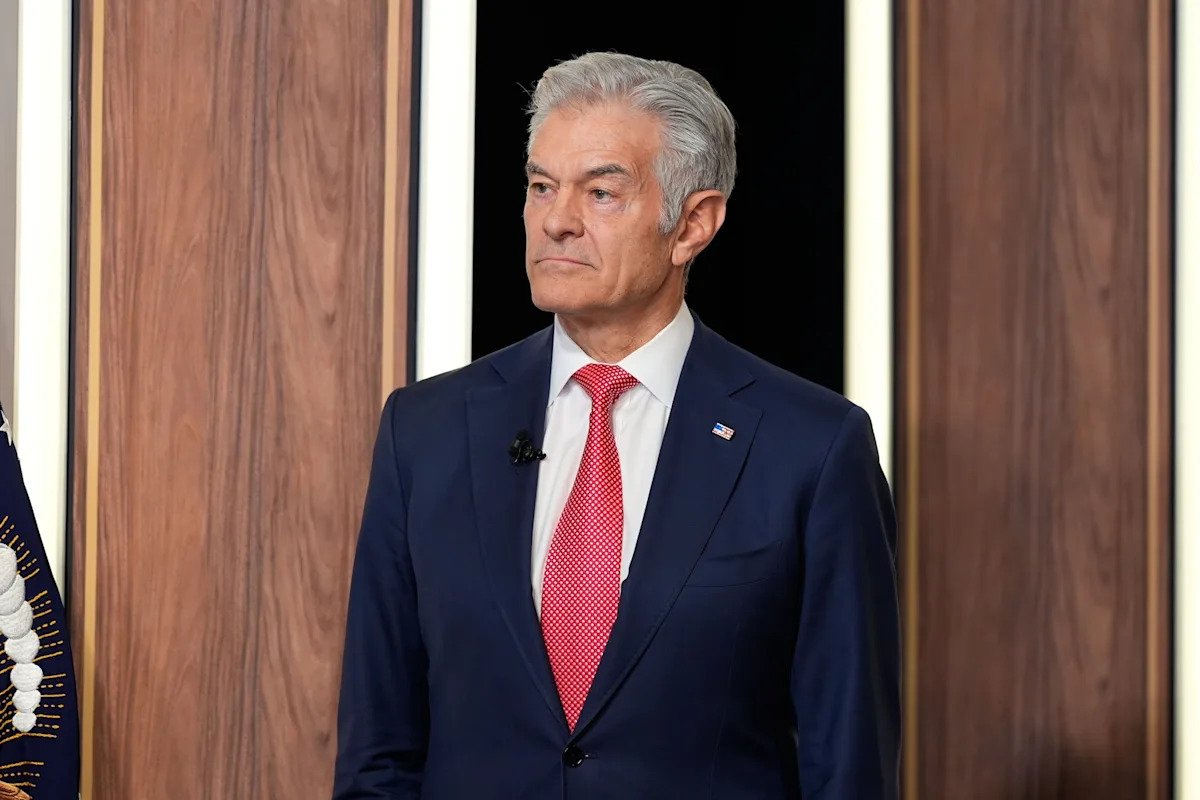
Earlier this week, Dr. Mehmet Oz encouraged Americans to get the measles vaccine in one of the most public statements supporting the shot from a top public health official within the Trump administration.
Oz, who is the administrator of the Centers for Medicare and Medicaid Services, appeared on CNN’s “State of the Union” on Sunday, warning about the dangers of measles amid a number of outbreaks around the country.
“Take the vaccine, please. We have a solution for our problem,” Oz said. “Not all illnesses are equally dangerous, and not all people are equally susceptible to those illnesses. But measles is one [where] you should get your vaccine.”
Some infectious disease experts praised Oz for publicly endorsing the vaccine and not downplaying how serious the disease can be.
His comments come as the U.S. struggles to control the spread of measles with more than 700 cases so far this year, according to the Centers for Disease Control and Prevention (CDC). This is the third-highest number of annual cases since measles was declared eliminated from the U.S. in 2000.
New map shows how to spot the measles risk level in your ZIP code
Some experts noted that Oz’s comments appeared to stress the importance of vaccination more than those made by Health and Human Services Secretary Robert F. Kennedy Jr., whose department oversees Oz’s agency.
While Kennedy has acknowledged that the measles, mumps, rubella (MMR) vaccine helps prevent the spread of disease, experts say he has also promulgated misinformation about the vaccine’s safety and efficacy and reiterated his belief that the decision to vaccinate is a personal one. This doesn’t address how contagious measles can be, including for children who are too young to have been vaccinated.
In a statement to ABC News, an HHS spokesperson said the agency’s leadership “has consistently said that the MMR vaccine is the best way to prevent the spread of measles and protect public health.”

Alex Brandon/AP – PHOTO: Centers for Medicare & Medicaid Services administrator Dr. Mehmet Oz listens as President Donald Trump speaks about TrumpRx on Feb. 5, 2026, in Washington, D.C.
Experts praise Oz’s vaccination appeal
Dr. William Schaffner, a professor of preventive medicine at Vanderbilt University Medical Center in Nashville, told ABC News that he’s hopeful Oz’s comments will resonate with some parents who have been hesitant to get their children vaccinated.
“He’s a prominent administration official and a prominent person in his own right, who’s well recognized by many people in the United States,” Schaffner said. “His strong affirmation and encouragement of measles vaccination was very welcome.”
Schaffner added that the current recommendation from CDC, recently updated by Kennedy’s HHS, is for all children to receive two doses of the MMR vaccine, the first at ages 12 to 15 months and the second between ages 4 and 6.
“Dr. Oz’s comments are an emphasis, a reemphasis and an affirmation of those recommendations,” Schaffner said.
4 times as many measles cases in a few weeks than US typically averages in a whole year: CDC
Dr. Peter Hotez, dean of the National School of Tropical Medicine at Baylor College of Medicine and co-director of the Texas Children’s Hospital Center for Vaccine Development, said it’s not surprising Oz made positive statements about the need to get vaccinated because he was also supportive of the COVID-19 vaccine during the pandemic.
Hotez said he appeared on “The Dr. Oz Show” — the talk show that Oz used to host — during which Hotez spoke about the importance of keeping up with vaccination.
“I was appreciative because it was reaching an audience that I ordinarily wouldn’t get the chance to meet or talk to,” Hotez told ABC News. “So, I was glad to do it, and so I’ve always been a supporter of Dr. Oz from that standpoint. I think he’s always been pretty positive on vaccines.”
Kennedy’s contradictory comments on vaccination
Some public health experts noted that Oz struck a different tone than Kennedy has on vaccines.
During his “State of the Union” appearance, Oz defended Kennedy, stating that he believes Kennedy supports people receiving the MMR shot.
“We have advocated for measles vaccines all along. Secretary Kennedy has been on the very front of this,” Oz said.

Heather Diehl/Getty Images – PHOTO: Secretary of Health and Human Services Robert F. Kennedy Jr. speaks at The Heritage Foundation on Feb. 9, 2026, in Washington, D.C.
Despite receiving pushback from host Dana Bash, Oz held firm, saying Kennedy made comments in support of the MMR shot when a measles outbreak began in West Texas last year. The outbreak ultimately led to more than 700 cases and two deaths among unvaccinated school-aged children.
After meeting the families of the children who died with measles, Kennedy commented on the vaccination in an April 6 X post.
“The most effective way to prevent the spread of measles is the MMR vaccine,” he wrote.
However, days later he said that the vaccine had not been safely tested and that it only offered short-term protection — assertions that public health officials say are not true.
Some public health experts similarly told ABC News that they are skeptical of Kennedy’s support for the MMR vaccine.
“I don’t know where Dr. Oz is coming from,” Hotez said. “I mean, Mr. Kennedy has consistently done all he could during his time in office at HHS to undermine public confidence in the measles, mumps, rubella vaccine.”
While Kennedy downplayed the measles outbreak in Texas about a month after it began — calling it “not usual” — he issued a “call to action” after the first pediatric measles death.
1 year since measles cases found in Texas, US still seeing surge of infections with elimination status at risk
“Vaccines not only protect individual children from measles, but also contribute to community immunity, protecting those who are unable to be vaccinated due to medical reasons,” Kennedy wrote.
However, he added that parents should consult with doctors to “understand their options to get the MMR vaccine” and that “the decision to vaccinate is a personal one.”
Since then, Kennedy has wavered between making supportive statements about the measles vaccine and spreading misinformation about the shot.
During an interview on Fox News with Sean Hannity in March, Kennedy said measles vaccines do “stop the spread of the disease” but also that they cause “adverse events.”
“It does cause deaths every year. It causes all the illnesses that measles itself [causes], encephalitis and blindness, et cetera,” he told Hannity, without providing evidence.
Researchers say decades of studies has shown the MMR vaccine is safe and effective and that there’s no evidence vaccination leads to severe outcomes or outcomes similar to what the measles virus infection causes.

Sean Rayford/Getty Images – PHOTO: A worker with the South Carolina Department of Public Health talks to a patient outside a mobile clinic offering free measles vaccinations on Feb. 6, 2026, in Spartanburg, South Carolina.
“Even regarding the measles vaccine, [Kennedy will] say, ‘You should get a measles vaccine, but make sure you understand the risks,'” Dr. Paul Offit, director of the Vaccine Education Center and an attending physician in the division of infectious diseases at Children’s Hospital of Philadelphia, told ABC News. “He always sort of couched it in risk-benefit terms, as if there are serious risks for the measles vaccine, which just isn’t true.”
In April, Kennedy said the MMR vaccine is “leaky” because its effectiveness wanes over time by more than 4% annually, which doctors dispute. Hotez said some research has shown MMR vaccine effectiveness wanes by about 0.04% every year.
However, some experts said they are most concerned that Kennedy has not yet addressed the measles outbreak in South Carolina, which has led to more than 900 cases between October 2025 and Feb. 10 of this year, making it one of the largest U.S. outbreaks in years.
“You get to 1,000 cases, you’re again talking about children being at risk of dying,” Offit said. “The mortality rate for measles is one to three per thousand [cases]. … This is a worrisome time; this is a red flag moment to stand up for the health of America’s children. He’s the nation’s number one public health officer and he says nothing as these cases continue to mount and as we get closer and closer to more children dying from measles.”
An HHS spokesperson told ABC News that CDC is working closely with health officials in South Carolina and is holding regular coordination meetings.
The spokesperson added that CDC is providing $1.4 million in financial assistance, which South Carolina has requested, and that the agency will provide technical assistance, laboratory support, vaccines and therapeutics upon request.
Amid growing Texas outbreak, how contagious is measles?
President Donald Trump has also not addressed recent measles outbreaks, including in South Carolina. Last year, Trump wrote a post on social media calling for the combined MMR to be broken up into three total separate shots.
He has previously lamented that children are given too many shots, recommending that they be spaced out. On the campaign trail in 2024, he vowed to defund schools that mandate vaccines, but did not specify if he was referring to COVID-19 vaccines or all vaccines.
Impact of Oz’s comments
Although public health experts praised Oz’s comments, they are not sure the words will have much impact in stemming the spread of disease or increasing vaccine uptake.
Hotez said Oz does not oversee any of the federal agencies that shape vaccine policy nor does he have the power to make federal public health policy decisions, limiting the impact of his words.
“He doesn’t oversee FDA, doesn’t oversee NIH, he doesn’t oversee CDC, he doesn’t oversee the ACIP advisory committee,” Hotez said. “I mean it’s great that he made those positive statements. … So, there may be indirect benefits. Better he said it than he didn’t, but hard to say how much impact” it will have.

Sean Rayford/Getty Images – PHOTO: A sign is shown outside a mobile clinic offering measles and flu vaccinations on Feb. 6, 2026, in Spartanburg, South Carolina.
Schaffner added that, although positive recommendations at the federal level are important, local leaders will be far more successful at combatting vaccine hesitancy in their own communities.
“A lot has to be done at the local level where local influencers can have more influence than Dr. Bill in Nashville or even others at the federal level. So, it has to be a combination,” Schaffner said. “Certainly, all the positive messaging we can get from the federal level will augment and support what people are doing at state and local health departments and what local family doctors and pediatricians are doing day by day in speaking to parents about vaccinating their children.”
ABC News’ Dr. Jade Cobern contributed to this report.
