


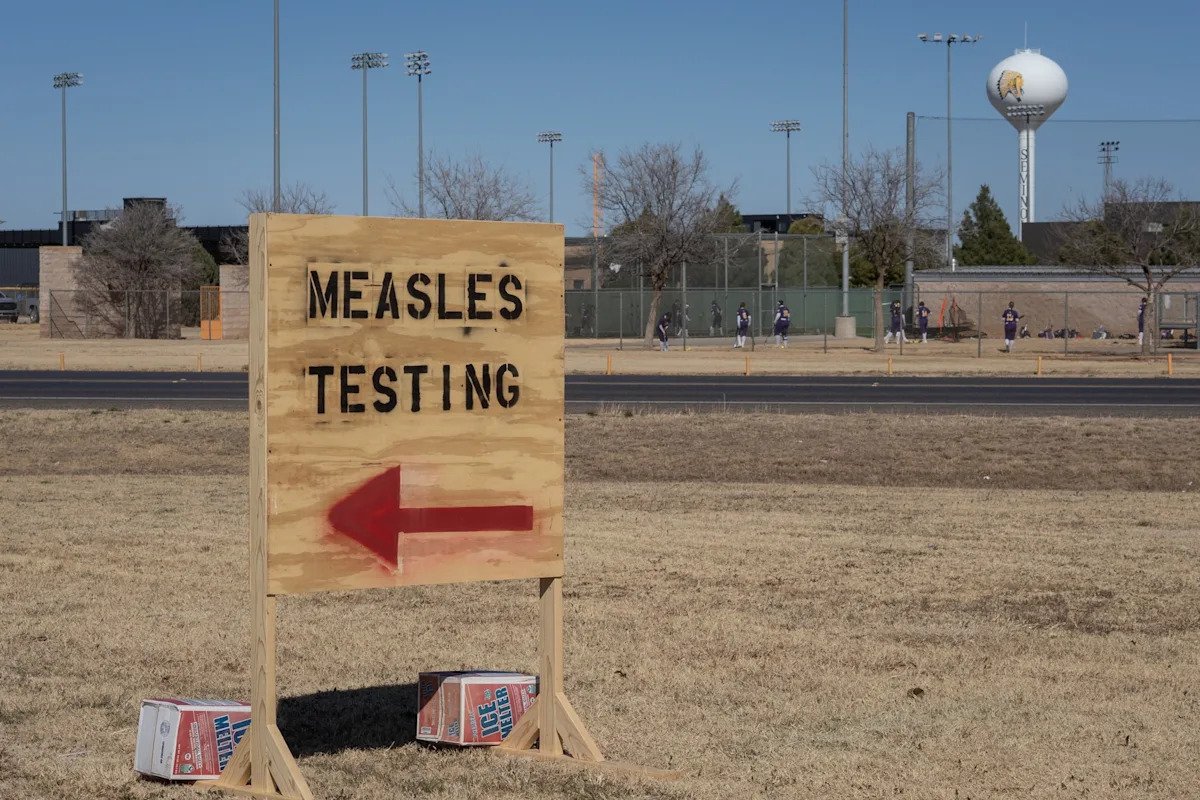
One year ago, health officials confirmed that cases of measles were cropping up in a small town in western Texas.
Soon, the virus had spread to neighboring counties in Texas. Other states began reporting their own measles outbreaks, including Utah and South Carolina.
By the time 2025 ended, more than 2,200 cases had been confirmed, the highest number reported in the U.S. in 33 years, according to data from the Centers for Disease Control and Prevention.
New map shows how to spot the measles risk level in your ZIP code
The U.S. also saw its first measles deaths in more than a decide including two among unvaccinated school-aged children in Texas and one among an unvaccinated adult in New Mexico.
It’s unclear if the cases in Texas that were confirmed on Jan. 20 are linked to those in other states; if so, it would mean the U.S. has seen a year of continuous transmission.
If it’s determined that the U.S. has experienced 12 months of continuous measles transmission, it could lead to a loss of the country’s elimination status that was earned in 2000. Measles would once again be considered endemic or constantly circulating.
“Back in the year 2000, the United States was declared free of measles. We had eliminated measles from our shores, and that was an incredible achievement for public health,” Dr. Richard Besser, president and CEO of the Robert Wood Johnson Foundation and acting director of the CDC during former President Barack Obama’s administration, told ABC News. “The fact that we’ve seen measles at incredibly high levels over this past year is concerning.”

Jan Sonnenmair/Getty Images – PHOTO: Signs point the way to measles testing in the parking lot of the Seminole Hospital District across from Wigwam Stadium, Feb. 27, 2025, in Seminole, Texas.
The loss of status is determined by the Pan American Health Organization, an agency of the United Nations that oversees international health in the Americas.
An independent body of experts established by the PAHO — known as the Measles, Rubella, and Congenital Rubella Syndrome Elimination Regional Monitoring and Re-Verification Commission — meets at least once a year to monitor and re-verify measles and rubella elimination among countries in the region.
A person familiar with how PAHO determines loss of elimination status previously told ABC News there would have to be compelling evidence that there has been continuous spread of measles in the U.S. since Jan. 20.
Last week, PAHO announced that it is inviting the U.S. and Mexico to meet virtually on April 13 to review their elimination status.
“If the cases in South Carolina, for instance, are linked to the cases in Texas, meaning they worked their way around the country, and they’ve been spreading for a year, then it’s likely that the Pan American Health Organization will remove our certification of elimination,” Besser said.
Mexico has similarly seen a measles outbreak with more than 5,900 cases reported last year, according to the WHO.
At least 171 measles cases confirmed in 9 states: CDC
The threat of the U.S. losing its elimination status is looming after Canada lost its measles elimination status following a struggle to contain a year-long measles outbreak, public health experts told ABC News.
PAHO did not immediately reply to ABC News’ request for comment.
It’s unclear if PAHO will remove measles elimination status from the U.S. but, even if the agency doesn’t do so, Besser believes “it’s just a matter of time.”
He explained that kindergarten vaccination rates have dropped from the 95% threshold needed to achieve herd immunity to just 92%, and that there are pockets of the U.S. with very low vaccination rates, which could allow the virus to spread more easily.
A recent map from ABC News — in collaboration of researchers from Boston Children’s Hospital, Harvard School of Medicine and Icahn School of Medicine at Mt. Sinai — that allows people to type in their ZIP code and see the measles risk in their area found a wide range of risks.
Some counties and ZIP codes fell into the “lowest risk” with 85% or more of children under 5 years old receiving one or more measles vaccine dose to “very high risk” with fewer than 60% of children under age 5 receiving one or more measles vaccine dose.

Jan Sonnenmair/Getty Images – PHOTO: One year-old River Jacobs is held by his mother, Caitlin Fuller, while he receives an MMR vaccine from Raynard Covarrubio, at a vaccine clinic put on by Lubbock Public Health Department, March 1, 2025, in Lubbock, Texas.
Experts have said it’s not easy to confirm that the virus responsible for the measles outbreak in Texas, which began in January 2025, is the same one circulating in Utah or South Carolina.
The CDC has neither confirmed that the outbreak in Texas is linked to outbreaks in other states nor confirmed that there has been sustained continuous transmission.
However, David Heaton, public information officer at the Southwest Utah Department of Public Health, told ABC News last week that cases in southwest Utah and further north have been linked to the same measles virus that spread in Texas and New Mexico last year — and he’s worried about the loss of elimination status.
“That’s kind of a discouraging threshold that we’re getting closer to. I think [the loss of elimination status] could be recovered, but it could take a couple of years at least,” Heaton said.
Besser said he’s not sure how long it would take the U.S. to regain elimination status if it’s lost, or if the U.S. even could, but encourages parents to vaccinate their children if they haven’t done so already.
“The Academy of Pediatrics has vaccination guidelines that are evidence-based that I think provide a good resource for pediatricians and for families who are looking to understand what to do,” he said. “Talk to someone, talk to a health professional you trust, if you are fortunate enough to have one.”
ABC News’ Youri Benadjaoud and Dr. Jade Cobern contributed to this report.
