


Every year, when the clock strikes midnight on Dec. 31, many of us like to take part in the collective delusion that we will magically become an entirely new person. Someone who wakes up at 6 a.m., drinks untold gallons of water a day, hits their 10,000 steps and glows from the inside, from both inner peace and green juice. Someone who journals, calls their mother and finally writes that novel.
We know, of course, that many New Year’s resolutions flame out, but that’s also the point — transformation is kind of a drag. It happens slowly and unevenly, with plenty of misfires and false starts along the way. If you’re truly determined to make a change, research has shown that the most durable shifts don’t come from dramatic reinventions, but from small, consistent tweaks to the way we move through our days.
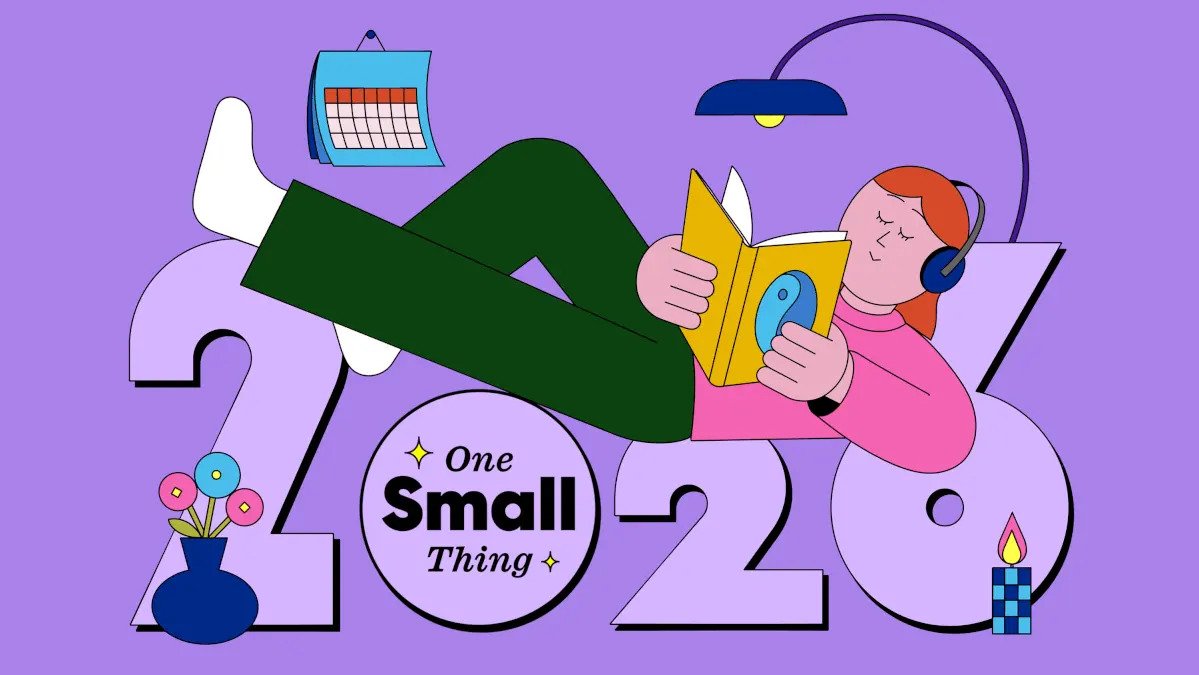
In that spirit, to kick off the new year, we asked a mix of experts, writers, artists, internet personalities, celebrities, public figures and other fascinating people about the one small habit that’s made a meaningful difference in their lives. We heard about everything from lifting heavy weights and putting the phone to bed at night to writing notes of appreciation to strangers and getting lost to reignite your creative spark.
None of these habits promise an overnight transformation. But together, they offer something more hopeful: proof that change doesn’t have to be radical to be worthwhile, and that the smallest things, done consistently, are what quietly shape a life.
1. Follow the one-minute rule
If I can do a task in less than a minute, I do it immediately. It’s astonishing how many tasks fall into this category — hanging up my coat, filing a document, deleting a blurry photo, putting the lid back on the peanut butter. Before I started following this rule, these tiny tasks formed a scum of clutter that covered the surface of my life. Once I began taking care of them right away, I felt immediate relief with the greater level of order and calm in my surroundings.
For me — and for many people — outer order contributes to inner calm, and the one-minute rule creates that outer order in a way that feels effortless. I’m not adding anything to my schedule; I just shift small tasks to the moment when they’re quickest and easiest to do. The result? More clarity, more energy and far fewer nagging reminders tugging at my attention — plus I spend a lot less time searching for misplaced items. It’s a simple habit, yet it’s a powerful tool to help make my days run more smoothly and to create an environment that supports my happiness.
— Gretchen Rubin, bestselling author and host of Happier With Gretchen Rubin
2. Don’t put it down — put it away
If you put something away where it belongs, the next time you need it, you’ll know exactly where to find it, saving you the time and headache of looking for it. And by putting items away immediately, instead of piling them up on horizontal spaces, you will keep clutter to a minimum. Incorporate this habit into your everyday life, and you’ll be living clutter-free in the new year.
— Tracy McCubbin, founder and CEO of dClutterfly
3. Clean your house every Saturday morning
Once I hit adulthood with a house and children, my husband and I hired a cleaner to come every two weeks. I was never particularly comfortable with the practice, as I felt people should clean up after themselves. But a combination of busyness, having the money and not liking to clean led to inertia. Then two things happened: COVID (and cleaning ourselves) and a conversation with a personal trainer named Mia Lazarewicz, who told me that her 90-year-old clients had one thing in common: They all cleaned their own homes. So we decided to do it ourselves even after COVID.
Now the house is cleaned the way we like it, we’re saving money and I feel like we are preserving our health for the long term. I think this country can (and should) provide better jobs to immigrant women than cleaning other people’s houses. And doing it oneself keeps us more empathetic with people who earn little and do what sociologists call “dirty work.”
— Juliet Schor, sociologist, economist and professor at Boston College
4. Develop a packing list for all occasions
Because we spend so much time traveling, I have a checklist … for every destination you could possibly go to, from winter beanie hats and vitamins to bathing suits and sunscreen. I will never forget a major packing item anymore because I have to go through my checklist every time.
— Brooke Williamson, chef and television personality
5. Take yourself on a money date
Once a month, I have a “Money Date” with myself. So I look at what came in, what went out and what I’m avoiding, lol. It has changed my life and turned managing my finances from something I avoid to something I manage. Truly a tiny habit that has a massive return on investment.
— Haley Sacks (aka Mrs. Dow Jones), host of “Financial Tea With Mrs. Dow Jones”
6. Eat three different vegetables every day
When I created dense bean salads, it was a way for me to implement consistency in adding healthy foods to my diet. The change I saw in my skin and mental and physical health from consistently eating a variety of vegetables was shocking.
In America, there are so many health foods marketed to us, but few options are better for you or as affordable as eating more vegetables. Making a conscious effort to include at least three different veggies in your diet daily makes you much more aware of what you’re eating. It helped me switch from a mindset of, “Does this contain things that are bad for me?” to “Does this contain things that are good for me?” It makes it a lot easier to incorporate more delicious, healthy ingredients into your meals.
— Violet Witchel, recipe developer and creator of dense bean salads
Photo illustration: Andrea Chronopoulos for Yahoo News
7. Have chicken (and a muffin) for breakfast
I get up every morning, and I either have a piece of chicken or a couple of scoops of chickpeas to start my day with protein. Then I feel less guilty about the muffin. … It does start with the protein, then we get the muffin.
— Alex Guarnaschelli, chef, cookbook author and TV personality
8. Skip the coffee jitters
I’ve started to make sure that I don’t begin my days with coffee. I noticed that when I did, I’d be incredibly anxious for the first half of the day, which led me to overthink every single thing. I realized that having coffee on an empty stomach triggered something in my brain.
Now, when I wake up and start my day, I make sure I have some water, take my time and eat before I get coffee. It seems small, but it’s helped my mental health a ton. I’m still an overthinking person, but it’s less anxiety-inducing these days.
— Terrence Gutiérrez, baker, food content creator and Substack writer
9. Be satiated to be less of a b****
One thing that has helped me as a 57-year-old woman, which I learned on my podcast, is eating more high-quality protein. It’s so shocking how focusing on protein, especially getting 30 grams of protein in the morning, has changed my body composition. I’m not such a bitch because I’m satiated. I have more energy and focus, and so that’s one thing I’m going to keep doing.
— Mel Robbins, bestselling author and host of The Mel Robbins podcast
10. Cut back on booze
This wasn’t necessarily a huge change, but as I’ve gotten older, I can’t drink anymore. I just don’t. The hangovers are just not worth it. I feel so much better now — I’m ready for anything. I could run the next day if I wanted to — I won’t. I had a lot of fun in my 20s, and now hydration is key. I’m the girl who likes to stay in, do a face mask and drink a jug of water, and I feel great.
— Brittany Snow, actress
11. Go to bed
Good sleep hygiene will definitely change your life. It’s hard because you have to be really disciplined about what time you go to bed and when you wake up, and make your room as quiet and as dark as possible. No phones, no screens and no light.
— Erika Jayne, TV personality and former cast member of The Real Housewives of Beverly Hills
12. Pump some serious iron
Lifting weights! It builds your brain. It fights depression. It builds bone mass. Because of my age, the greatest thing I have done for myself in the past year and a half is weightlifting — serious weightlifting. I use everything from 10- to 25-pound weights in the gym, and I love it. I go to the gym as early as 3:45, 4 o’clock in the morning if I’m at home in Italy. Here in America, we have to go to the gym at 5 a.m. when Crunch opens, and on weekends, you have to wait all the way until 7 a.m. That kills me. It’s practically noon.
— Rachael Ray, chef and television host
13. Pulverize an MMA dummy
I got a dummy in my backyard, like an MMA dummy. Now, when I’m really frustrated, I f***ing beat it up, and it feels so good. It’s a really good way to release a lot of inner tension.
— Olivia Tiedemann, chef and restaurateur
Photo illustration: Andrea Chronopoulos for Yahoo News
14. Embrace your inner Pilates princess
Pilates. I’ve had a bunch of injuries. It’s been really good for my recovery. I like the reformer.
— David Chang, chef, restaurateur and host of The Dave Chang Show
15. Do it today, so you can do it tomorrow
My quick morning exercise routine has done wonders for preventing otherwise debilitating back and neck pain. When I first experienced that pain decades ago, a physical therapist promised that if I stretched, strengthened and increased muscle flexibility for 10 minutes every morning, the pain would be relieved and reduced. Over the years, I’ve added some moves, so the routine is now 20 minutes, but that’s still short enough, so there’s no excuse not to do it. I’ve been advised, “If you can do it today, you can do it tomorrow.” I believe it. It’s worked for me.
— Marion Nestle, nutritionist, molecular biologist and professor emerita at New York University
16. Set a fitness goal for every decade
Setting one physical goal for each decade has helped me over the years. In my 40s, I trained for and ran a half-marathon. In my 50s, I learned to hold a handstand without the wall. In my 60s, I trained until I could do an unassisted pull-up (at 62, I’m up to three and hope to continue racking them up).
Each goal felt out of reach when I chose it. Achieving each of them was almost a spiritual moment for me. It’s not like I had an audience for any of them. The private dedication it took to get there helped me through hard times in my life and made me appreciate the good ones. For me, it’s less about the goal and more about the routine and small habits that get me to each one. It definitely spills into the rest of my life.
— Lorraine C. Ladish, writer, entrepreneur and cofounder of Viva Fifty Media, a community celebrating life after 50
17. Rain or shine, take a walk
Almost every morning, rain or shine, my wife and I take a 3-mile walk around our neighborhood. It’s often painful, sometimes sublime, but it’s absolutely essential to our day. We talk. We make plans. We rant about politics. We stop to chat with neighbors or admire the suburban wildlife.
Our morning walk is where ideas are born and books are edited. It’s so crucial that we go for our walk that we’ve adopted the unofficial United States Postal Service motto as our own: “Neither snow nor rain nor heat nor gloom … stays these couriers from the swift completion of their appointed rounds.”
Walking really is a magic cure for people who want to think straight. “Solvitur ambulando,” said Diogenes the Cynic two millennia ago. “It is solved by walking.”
— Austin Kleon, bestselling author on nurturing creativity, adapted from his book Keep Going
Photo illustration: Andrea Chronopoulos for Yahoo News
18. Keep things moving
As John Oliver would say, Sonja, ‘What are the poop pills?’ I have to say, they changed my life. Even Bethenny Frankel was asking me, ‘How do you keep things moving?’ So you take two magnesium pills before you go to bed, and one for the day. … It keeps your digestion moving. And of course, fiber. You put those things together. Also, a healthy shake. But don’t make it too liquidy. It should have some fiber left to it.
— Sonja Morgan, reality TV personality
19. Ratchet up the intensity
Hands down, the single most impactful tweak in my well-being has come as a result of training with intensity. I had always worked out, but I was stalled. I wasn’t seeing or feeling any difference, and after age 50, fitness and vitality seemed like an ever-receding shoreline.
Until… I started training with intensity. This meant two to four times a month doing workouts so intense that they literally left me needing to sit down for a break, gasping for air and grimacing through the last rep. Otherwise, I was exercising six days a week, but not all of them were that intense — they can’t be. But two to four times a month, pushing myself beyond what is pleasant has transformed my body composition and my fitness. Yes, it is possible after 50, but yes, it is intense. As the saying goes, if you want something you’ve never had before, you have to do something you’ve never done before.
— Dr. Jen Ashton, ob-gyn, former chief medical correspondent for ABC News and founder of the Ajenda
20. De-stress with yoga
That releases my stress — I’m all about the namaste. Since I went away [to prison], that’s where I was doing it every single day. And then when I came home, I got my certificate. I wanted to open up a yoga studio. But then I was nervous being in the public eye, I don’t need anybody suing me, so I just figured, let me stick to doing yoga myself.
— Teresa Giudice, television personality and star of The Real Housewives of New Jersey
21. OK, post!
I have a mantra — OK post! — that reminds me that done is better than perfect. Once something I’ve created is out in the world, I can reflect, learn and improve. I get no opportunity for growth if I’m being too precious about an idea to get it done. So, OK post!
— Shawna Lander, actress and content creator
22. Get lost to become unstuck
In my 20s, whenever I had to drive through parts of the country unknown to me, I’d sometimes pull into a small town, find the nearest phone booth, point to a number in the phone book and call it. I’d explain to whoever answered that I was just passing through and would love the suggestion for a place to eat. They’d often laugh (this was the ’90s; people still answered their phones), then after some musing (“Oh god, what is the name of that — Steve, do you remember where Ray had his 40th?”), would offer up a place. It occurs to me now how strange and wonderful it is that I have no memories of people hanging up on me. Either I have blocked out rejection (possible), or we were all better at connection then. Either way, I had some memorable meals.
Nowadays, I’d be hard-pressed to find a phone book. But what I still do when I’m feeling stuck: I turn off my phone, point to a random subway stop and spend a few hours wandering. Ask the locals where to find the best doughnut, the best bodega and what makes their neighborhood special. I jokingly say it’s a way to re-Alice myself. But for those few hours, the world feels a little more real.
— Alice Wu, filmmaker and writer-director of Saving Face and The Half of It
23. Do your future self a favor
One small thing that’s made a huge difference in my health and wellness is being disciplined about my choices and thinking of it as, “My future self will thank me for what I’m doing right now.” [It’s a] little mind trick, establishing a conversation between present and future me. I’ve done it for many years, and it really works.
— Danica McKellar, actress and education advocate
24. Give ‘someday’ a deadline
I’ve spent too much of my life waiting until I’m more ready, more prepared, more whatever — but someday isn’t a day of the week; it’s just a comfortable lie I tell myself to avoid starting. Turns out, 50%, 60%, even 70% ready is good enough to go for it. I’d rather bet on myself at half-ready than wait forever for perfect.
— Roxy Couse, creator and workplace culture commentator
25. Become great in the after-hours sessions
In the stock market, stories on companies are told after the stock market closes. We call this after-hours trading. It’s time to take a page from after-hours stock trading and apply it to your personal life. That time you spend honing your craft when no one is looking is what often separates the greats from the average.
— Brian Sozzi, executive editor of Yahoo Finance
26. Spend 15 minutes creating without an agenda
One small habit that has meaningfully changed my life is spending 15 uninterrupted minutes a day creating without an agenda. Sometimes I write, sometimes I sketch, sometimes I just brainstorm ideas. Giving myself time to be creative without an output helps me think more clearly and inspires me to approach work with less pressure.
— Agnes Hsu, entrepreneur and founder of the kids’ craft and activities blog, hellowonderful.co
27. Always exit for the world’s largest or smallest anything
One small habit that has genuinely changed my life is my commitment to visiting the world’s largest or world’s smallest anything. If I’m driving somewhere and spot a sign for the World’s Largest Ball of Twine or the World’s Smallest Post Office, I will — without hesitation — pull off the road and go. It’s a tiny ritual of joyful defiance in a world that keeps telling us to stay on task, stay productive, stay efficient.
These whimsical detours interrupt the heaviness (or slog) of everyday life — illness, caregiving, inboxes, the ache of being human — with something wonderfully unnecessary. Standing in front of a massive fiberglass turtle or the second-largest functioning fire hydrant does nothing to advance my to-do list, and that is exactly the point. These odd monuments to human enthusiasm remind me that delight is reason enough.
In a culture obsessed with optimization, these roadside wonders help me remember that joy isn’t earned through perfection or productivity. It’s something we can put ourselves in the way of — sometimes by simply taking the exit marked World’s Largest Mystery Object, 1 mile ahead.
— Kate Bowler, Duke professor, podcast host and author of the forthcoming Joyful, Anyway
Photo illustration: Andrea Chronopoulos for Yahoo News
28. Walk to work
Around 15 years ago, I bought a pedometer and started carrying it with me wherever I went. After just a few days of tracking my steps, I was shocked to discover how inactive I was! Motivated to make a change, I committed to walking to work each day regardless of the weather. What I didn’t realize at the time was just how transformative that small shift in my daily routine would become.
Not only did it improve my activity level, but it also gave me more opportunities to rest and restore by enhancing my exposure to green spaces, increasing how frequently I checked in with my friends and family over the phone and offering me invaluable mental space to let my mind wander and think creatively about projects and ideas. Switching from driving to walking to work turned out to be life-changing. It’s a habit I’ve stuck with ever since.
— Ethan Kross, professor at the University of Michigan, bestselling author and expert on emotion regulation
29. I’m serious, though; take a hike
Our small habit that changed everything is taking a daily walk outside, no matter the weather. We throw on our walking vests, unplug from our screens and give ourselves quiet time to simply move and breathe. The fresh air, the gentle rhythm of walking and the change of scenery always reset our minds.
— Radwa and Alia, the Food Dolls
30. Swim in the freezing cold ocean
I love swimming through the winter in the open water. Well, swimming is putting it a bit strong. I like trying to stay in for at least three minutes. People know the science on this — I’m not gonna bore people about it — it’s a very well-known life hack, and it’s great for mental health as well as physical health. So, it’s a wonderful way to reset, as any kind of immersion in water is, but especially when it’s that cold, it becomes an extraordinary kind of challenge and wonderfully renewing.
— Benedict Cumberbatch, actor
31. Run in nature
There’s a reason they say Mother Nature is the best medicine. It’s true: There’s nothing that feels more grounding than when your feet are on the soil, when you’re watching flowers bloom in real time, when you’re watching squirrels scatter from tree to tree.
— Sarah Shahi, actress
32. Relish mundane daily delights
My go-to practice is looking for delights — those little moments of pleasure and joy that are all around us. Research shows that we often feel happier when we experience gratitude, but taking time for gratitude can feel heavy during tough times or just when life is feeling overwhelming.
I find that looking for delights is a lot easier. It’s a practice I learned from the poet Ross Gay, who wrote a series of essays about daily delights. To harness delights, just train your mind to look for tiny moments of wonder all around you. For example, my delights today (which were all just on my morning commute) included noticing a stranger’s funny-looking cat tote bag, seeing a dad pat down a flyaway wisp of his toddler’s hair with a smile, and glimpsing a person inside her car happily jamming out to a song I couldn’t hear way too early in the morning. All of these were just small things, but they help me remember that there is beauty and humor and things we share even when the world feels like a lot. And those delights are all around if we just take a moment to notice.
— Laurie Santos, Yale University psychology professor and host of The Happiness Lab
33. Look for hearts everywhere
Every day, I look for hearts. Sometimes they’re obvious, sometimes they’re hidden in places you would never expect. A leaf on the sidewalk, the way my daughter’s snack broke apart, a cluster of bubbles during bath time. It started as something playful with my kids, but it’s become a steady practice that anchors me.
On the tougher days, it pulls me back into the moment. On the good days, it slows me down just enough to notice the joy I’d usually rush past. It’s my way of practicing gratitude without needing a journal or a perfect routine. Just a quick pause, a breath, a spark of delight. It’s a reminder that even in the noise of parenting, medicine and running a business, there are tiny signs of love if I’m willing to look up and catch them.
— Dr. Mona Amin, pediatrician and health communicator
Photo illustration: Andrea Chronopoulos for Yahoo News
34. Carve out time for fresh air with friends
I’ve become such a country girl — it’s wild. I live in Manhattan, but I get out to the country all the time. Just being out in nature and fresh air with friends — carving out time for those trips — that’s really important.
— Mischa Barton, actress
35. Avoid screens in the morning
Waiting an hour to look at my phone when I wake up in the morning has been good for my brain.
— Minka Kelly, actress
36. Put your phone to bed
Pick a time that you declare the end of your working day, and mark it by taking your phone and charging it outside your bedroom. If that seems very hard, start with one night a week. The reason for that is that the phone is the depository of every problem and every project. And to be able to surrender to sleep, we need to be able to separate ourselves from that. So, we even have produced a little phone bed that is a charging station that looks like a bed and has a little blanket. The idea is that you put your phone under the blanket, you tuck it in, you wish it good night and you reconnect in the morning. … I’ve been doing it consistently for 10 years, and it’s dramatically improved my sleep.
— Arianna Huffington, entrepreneur, bestselling author and CEO of Thrive Global
37. Play intergenerational charades
My brother’s family and my family live a few blocks away from one another and have the great joy of having a weekly dinner together. The four cousins — all elementary school age — were struggling with infighting, battles over iPads and other common kid drama, so we started a new tradition: intergenerational charades after dinner. Everyone gets to contribute clues (rock climbing, Taylor Swift, One Piece, Eames chair…), and it is a raucous, screen-free time for all.
— Courtney Martin, writer of The Examined Family on Substack, author of Learning in Public: Lessons for a Racially Divided America From My Daughter’s School
38. Lock yourself out of social media
I started using the Brick this year to lock myself out of social media, and it’s been the biggest upgrade I’ve made in years.
— Erika Veurink, author of Exit Lane, writer of fashion publication Long Live on Substack
39. Stay focused
During my medical residency, I survived 100-hour weeks and 26-hour shifts by becoming ruthless about optimizing my limited study time. One habit that made a huge difference was a two-step protocol: turning off all notifications AND physically removing my phone from my workspace entirely, placing it in another room during focused work sessions. I initially thought silencing notifications would be sufficient, but studies on cognitive load show that even a silent, powered-off phone on your desk impairs working memory and processing speed by up to 10%. The brain continuously expends cognitive resources trying to resist checking it, resources that would otherwise be used to support focus and problem-solving.
Now I batch all phone checking into scheduled breaks between work blocks. Since making that separation nonnegotiable, I finish tasks faster with fewer mistakes, and my focus feels steadier, especially when I’m already tired.
— Brandon Luu, physician and writer on Substack about applying science to everyday life
40. Take the internet off your phone
I have friends who are really good at focusing on their mental or physical health — massages, self-care — and I don’t do any of that. Someone recently asked me about my skin, and I was like, “I don’t think I’ve washed my face with soap in 15 years.” There’s no routine here!
The biggest thing has been the phone. It’s so easy to fall into that endless scroll. By switching to this phone with no internet, I actually communicate with people so much more than I have in the last 10 years. I’ve always been bad about communication — I’d tell myself I’d call someone later and then get too busy. Now, if I’m in the car or waiting at the airport, the only thing I can do is talk to people. So I call my mom or friends I haven’t talked to in a while. It’s opened up a lot more communication — and that’s made me feel happier and more grounded.
— Frankie Muniz, actor
41. No need to do it for the ’gram
Giving myself designated screen-free time while traveling. Not the entire trip — just one afternoon or one day where taking photos, filming content or checking my phone isn’t the priority.
As a travel writer and content creator, it’s easy for every moment to become an opportunity for a shot list or my next headline. Choosing structured offline time forces me to experience a place the way I did before I turned travel into a career: noticing small details, talking to people, getting lost on purpose and letting the moment unfold without looking behind the camera lens, thinking about how it will look online.
It helps reduce my stress, and no matter how far I further my career as a travel writer, it’s a reminder to continue to take a moment for me.
— James Barrett, travel writer
42. Pray
One of my daily rituals is prayer. My faith has an enormous effect on my day and my life. I spend time with God, and I carry these moments with me and lean on them often.
— Steve Guttenberg, actor
43. Decide how you want to show up today
I start every day by choosing my intention before the world gets a vote. Before emails, headlines or other people’s urgency, I ask one question: How do I want to show up today? Not what I need to accomplish, but who I want to be. That habit was forged when I was given 14 days to live, read my last rites, lost the function of a lung and realized control is an illusion, but intention is not. Mountains, cancer, business, life — none of them care about your plans, but all of them respond to how you show up. By setting my intention first, I stopped reacting and started leading myself. It’s a small daily decision, but over time it compounds into resilience, clarity and confidence, and those qualities change everything.
— Sean Swarner, two-time cancer survivor who climbed Mount Everest with one lung
44. Cuddle your pets
Taking a moment to give a thorough and loving hug to my cat, Mr. Rose.
— June Squibb, actress
Photo illustration: Andrea Chronopoulos for Yahoo News
45. Write notes of appreciation to strangers
One thing I try to do regularly is write really specific notes of appreciation to people I don’t know. Everyone loves appreciation, and we are a world that needs so much more of it. It’s silly to be stingy with appreciation. It might be that I go to a restaurant and have a really great interaction with a waiter, so I write to them about it. It might be that I write to a bookstore because their signage makes me laugh, or a website because the copy feels so deeply thought through. I’ll write a few specific things that were unusual or meaningful to me.
The reason that this is a discipline is because there’s almost always something else to do. But I want to acknowledge that behind most people’s work is a lot of deep care, a lot of obsession. We have so few ways to know that our efforts are being felt or where they even go. When I receive a note back — and I feel the emotion of the person writing back — it makes me feel like we’re connected. We’re tapping each other on the shoulder and saying, “Good job, keep going. This is great.”
— Priya Parker, author, expert on gathering and connection and writer of the Substack, Group Life
46. Take your mental health seriously
Prozac. We are here right now because of Prozac. Mental health is such a hidden illness. You can present however you want on the outside, but no one can really tell that you’re struggling on the inside. I think it’s really important to talk about it. There is such a stigma about it, and people look down upon it.
— Amanda Batula, Summer House cast member
47. Get over yourself and make small talk
I got over myself and started seeking out small-stakes interactions — those short but potentially meaningful exchanges that occur in everyday life. They might be with strangers, service providers, coworkers or neighbors, and their purpose is to learn how someone else sees the world, even for just one conversation.
To build this habit, I had to get over two barriers. First, I had to get over myself. I had to realize that showing interest in another person’s life was much better than focusing on myself or worrying about what other people thought of me. Then I had to learn to see the possibility of small-stakes interactions in my daily life. I had to learn to see the world as a much more social place.
— Jeffrey Hall, professor at the University of Kansas and coauthor of The Social Biome: How Everyday Communication Connects and Shapes Us
48. Zero in on what brings you peace
Meditating and praying. I believe in quiet time — grounding yourself. The world feels busier and louder than ever, and I’ve learned to calm myself. Whatever that looks like for you — meditation, prayer, nature — find the thing that brings you peace.
— Ali Larter, actress
49. Sign up for a weekly tennis lesson
It’s only an hour, but because it’s a standing appointment, I treat it like a nonnegotiable. I don’t take meetings on Fridays anymore — everything else moves, but my tennis lesson doesn’t. That shift taught me how to put myself on my own calendar with the same respect I give everyone else.
There are days I’m tired, busy or convinced I should squeeze in “just one more thing,” but showing up for that hour keeps me from sabotaging my health with excuses. It reminds me that my well-being isn’t optional, and making myself a priority, even in this tiny way, has changed everything about how I move through the rest of my week.
— Alyce Chan, comedian
50. Sit in your car with a candy bar
Every day, I do something just for me, unrelated to work or responsibility. It might be small, like sitting in my car with my favorite candy bar, or huge, like going to therapy. Each moment reminds me that I deserve love and care.
— Misha Brown, creator, podcast host and author of Be Your Own Bestie: A No Nonsense Guide to Changing the Way You Treat Yourself
51. Be a villager to have a village
This year, as I ramped up touring in a big way and experienced more career highs than ever before, I came home to New York City to find that so many friendships that I had neglected fell apart before my eyes. As someone who is chronically social and loves my friends deeply, this was super painful to experience. One thing that really changed my perspective is the saying, “In order to have a village, one must be a villager.”
I realized I couldn’t use “being busy at work” as a reason to not check in on those whom I love and care about. I started incorporating letter writing and weekly checkup calls into my schedule between airport stops and shows. I paid extra to move flights and blocked off dates on my calendar so that I could go to more birthday parties, baby showers and housewarmings. I learned how to have productive conversations where I could tell people how they hurt my feelings and also apologize for my own shortcomings. I realized the importance of telling people, “I love you, and I really value our friendship. Thank you for everything you’ve done for me.”
— Abby Govindan, comedian
52. Tell people you love them
Telling people that I love them daily transforms and deepens my relationships. Verbal praise is a love language that can strengthen our relationships and remind us not to take our loved ones for granted, whether they are family, friends or romantic partners. My mother died last year from breast cancer, and I’m so grateful to know she was aware of my immense love for her.
— Dr. Thema Bryant, psychologist, author and former president of the American Psychological Association
With reporting from Suzy Byrne, Kerry Justich, Taryn Ryder and Kelsey Weekman.
