


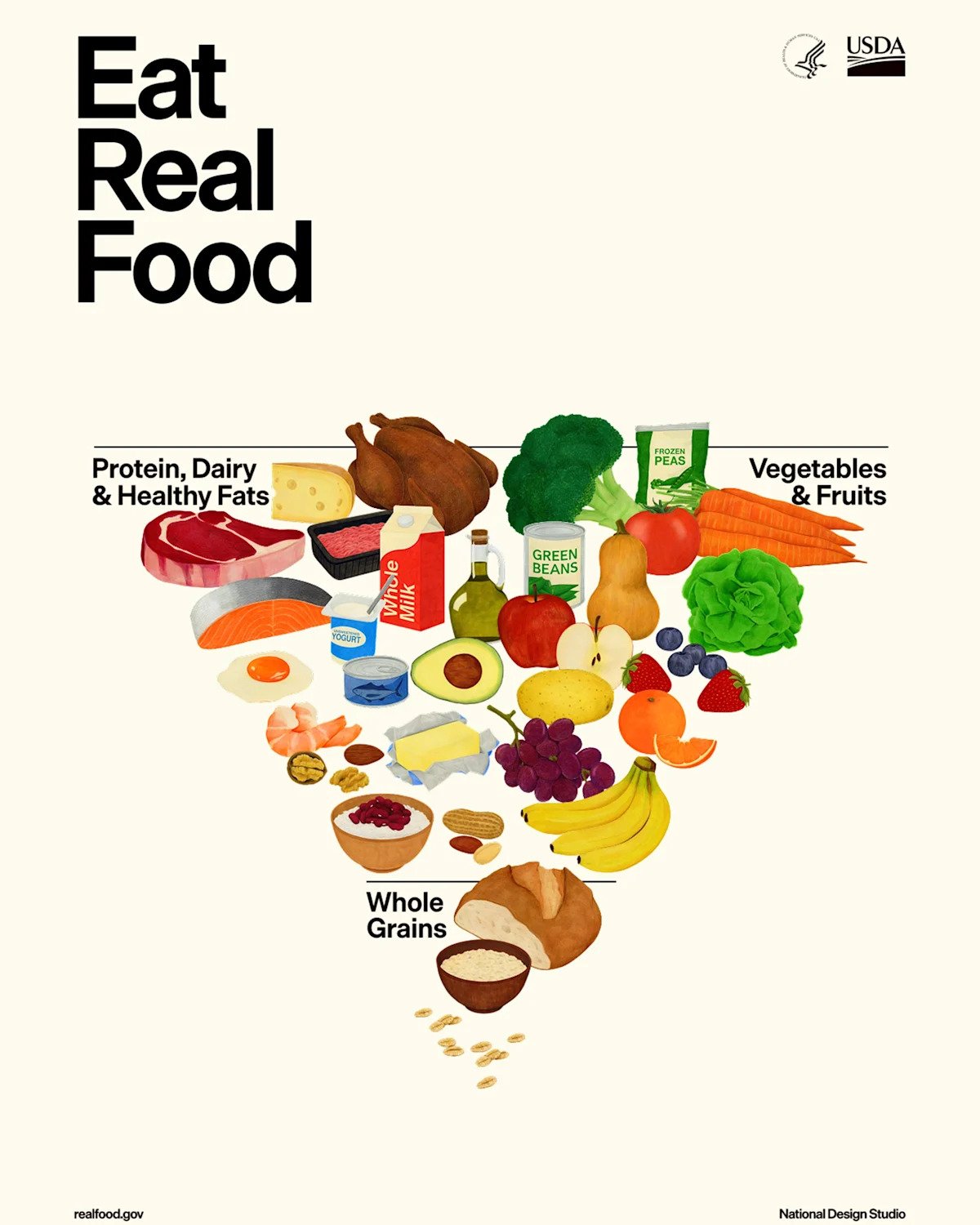
The U.S. Department of Agriculture (USDA) released a new set of dietary guidelines on Wednesday, Jan. 7, and it includes a food pyramid that looks very different from the one you probably remember.
Championing protein and healthy fats while minimizing grains, the new nutrition recommendations are a departure from past government guidance. In fact, the accompanying food pyramid visual is a near-complete inverse of what it once was, both visually and in terms of content.
In a White House press briefing, Press Secretary Karoline Leavitt touted the changes, saying the announcement aligned with President Donald Trump and Health Secretary Robert F. Kennedy Jr’s promises to “Make America Healthy Again.”
“As Secretary of Health and Human Services, my message is clear: eat real food,” Kennedy said of what he called “the most significant reset of federal nutrition policy in history.”
Used to seeing the pyramid of the early aughts? It may take you a moment to wrap your head around just how much has changed. Here are some of the standout differences between the old and new food pyramids.
New food pyramid: RFK Jr. overhauls dietary guidelines, calls for less sugar, more meat
What does the new food pyramid look like?
The United States stopped using the pyramid model for dietary suggestions in 2011 when it moved to a visual that more closely resembled a dinner plate. The RFK Jr.-led HHS has returned to the familiar relic of the ’90s and 2000s, effectively turning it on its head.
The upside-down triangle now features food groups that should be eaten in abundance at the top and those that should constitute less of your diet at the bottom.

New dietary guidelines released by the USDA on Jan. 7.
The old versus the new
The visual isn’t the only thing that was flipped. Grains, which were once the foundation of the suggested diet, are now the smallest group and relegated to the bottom. Protein, dairy, healthy fats, fruits and vegetables are the largest categories competing for the top.
“Protein” itself wasn’t a category on the popular diet visual until 2011, at which time it was still suggested in smaller portions. The latest guidelines not only focus on protein as a category, but the suggested intake has increased as it’s recommended to consume 1.2-1.6 grams per kilogram of body weight per day, up from the previous long-standing minimum of 0.8g/kg.
The attitude towards fats also made a near 180-degree turn. Previous nutrition guideline iterations suggested minimizing or avoiding full-fat dairy and all types of fat, including healthy and saturated. Now, three servings of full-fat dairy are recommended a day, and RFK Jr. declared that the USDA is “ending the war on saturated fats.”

The new dietary guidelines released USDA on Jan. 7 places a renewed emphasis on meats.
The guidelines now encourage the consumption of “healthy” fats, including saturated, placing it at the top of the pyramid in the same category as protein and dairy. It still caps saturated fat at 10% of your daily calories; however, it suggests these healthy fats come from naturally occurring, whole food sources, such as avocado.
The HHS is declaring a “war” on added sugar, placing a newfound focus on avoiding it or capping consumption at 10mg per meal.
Recommendations around alcohol consumption were also notably changed. Instead of placing a numerical limit on the number of drinks considered acceptable per day, which was previously up to one for women and two for men, it says simply to minimize consumption, stressing the “no amount of alcohol is safe” messaging less.
From pyramid, to plate and back to pyramid
The food pyramid, as we knew it, was first adopted by the United States in 1992, when the USDA released a four-level image. Food groups at the bottom of the pyramid were meant to reflect a larger portion of the recommended diet, while those at the top were supposed to be incorporated more sparingly.
This original iteration, from bottom up, featured:
6-11 servings of grains and starches, including bread, cereal, rice, and pasta.
3-5 servings of vegetables and 2-4 servings of fruit.
2-3 servings of dairy and meat, poultry, fish, beans, eggs and nuts.
A sparing amount of fats, oils and sweets.
The original pyramid was revised in 2005 to the “MyPyramid” model, which was still shaped like a triangle but featured color strips stretching from the top to the bottom to represent each food group, as opposed to ascending levels. This iteration was based on a typical 2,000-calorie-a-day diet and recommended, from bottom to top:
5.5 ounces of meat, fish, beans, eggs and nuts per day.
A “limited intake” of fats and oils.
In 2011, the United States transitioned to the MyPlate model, which switched up the visualization style. Gone was the pyramid; instead, an image of a dinner plate with color-coded slices represented how much of each food group should be present in people’s meals. It focused more heavily on individual needs, but generally reserved the largest portions for vegetables and grains, and smaller slices for protein, fruits and dairy.
This article originally appeared on USA TODAY: RFK Jr. updated the food pyramid. See what’s different for your plate.
