


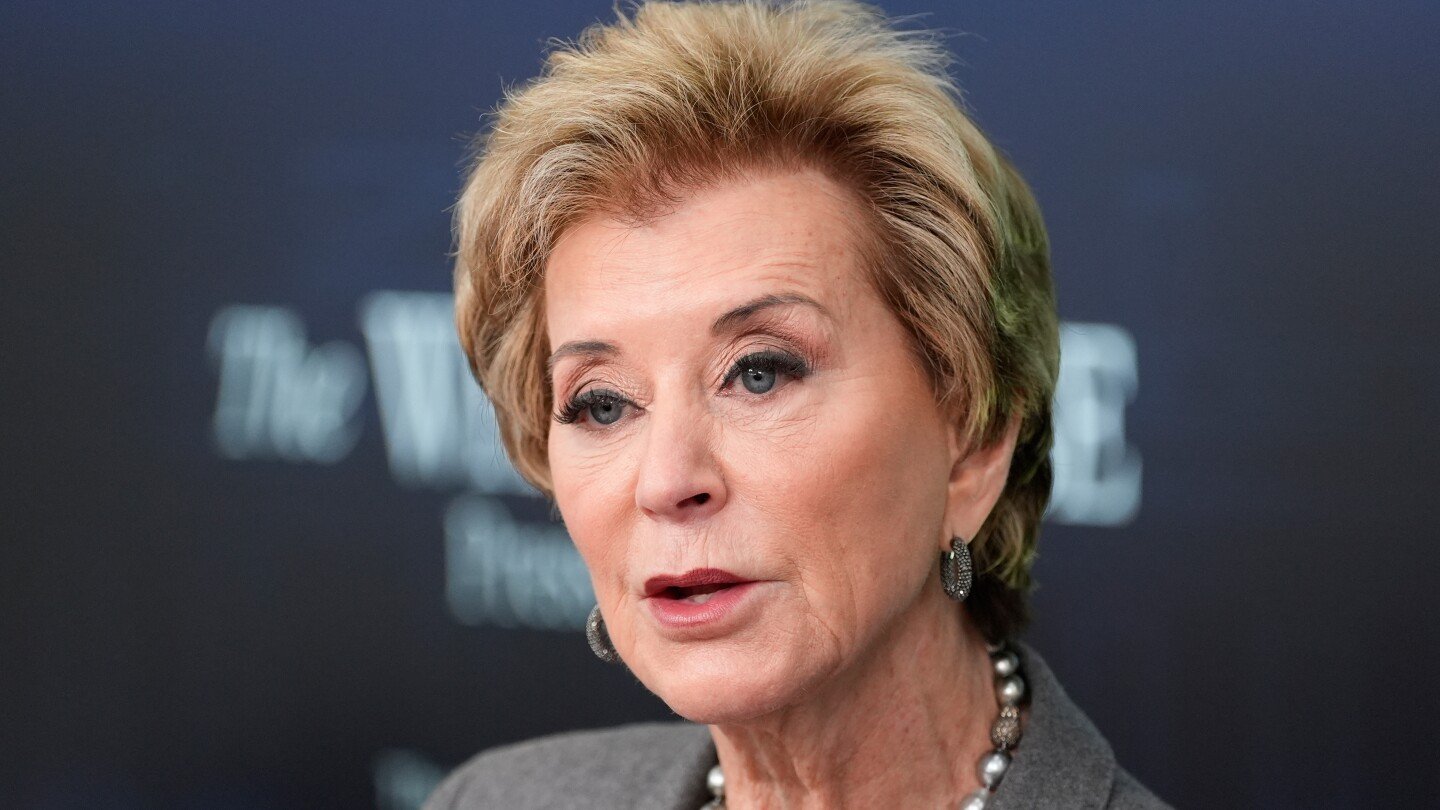
WASHINGTON (AP) — The Trump administration is giving Iowa more power to decide how it spends its federal education money, signing off on a proposal that is expected to be the first of many as conservative states seek new latitude from a White House promising to “return education to the states.”
Iowa was the first state to apply for an exemption from certain spending rules after Education Secretary Linda McMahon invited states to request the flexibility last year. Such waivers have been offered for years but are finding new interest as Trump officials leverage all available tools to remove the federal government from local education.
McMahon formally approved Iowa’s plan Wednesday at an event in the state. Indiana and Kansas have also applied to be exempted from certain parts of federal education law, and leaders of other states have expressed interest.
McMahon told The Associated Press that the new flexibility will free up time and money now devoted to ensuring compliance with federal rules. With fewer strings attached, states can pool their federal dollars toward priorities of their choosing, including literacy or teacher training, she said.
“We are eliminating that sort of, not bottleneck, but that additional compliance for the states, and that’s just going to be incredibly helpful to the state,” McMahon said.
“It’s not going to have go through the Department of Education, and it’s going to flow directly more to the states,” McMahon said.
Iowa’s newly approved waiver applies primarily to education money used by the state’s education agency, not the larger sums of money that flow to the state’s more than 300 public school districts.
Under the arrangement, federal money from four programs — aimed at teacher training, English learners, after-school programs and academic enrichment — will be pooled into a single pot with fewer limits on how it is spent. Iowa’s plan will merge about $9.5 million over the course of the waiver, which runs through September 2028. How much goes toward one purpose versus another is up to state officials.
Iowa said it will save about $8 million in staff time that went toward making sure that spending complied with regulations.
The state will be required to show that it is still meeting the spirit of the federal laws behind each funding source.
Known as block grants, that funding model is a longtime dream of conservatives who say money from the federal government comes with too many strings attached.
Opponents say block grants would allow states to redirect money away from the students who most need the federal aid, including low-income students and English learners, and toward Republican priorities. Democrats in Congress urged McMahon to reject block grant requests in a letter in May, saying it would fail “the very students these provisions aim to support.”
The waiver approved for Iowa is far narrower than one initially proposed by the state in March. That one asked McMahon to combine 10 funding sources into a single block grant, both for the state’s education agency and for the state’s school districts. The early proposal requested flexibility for programs including Title I, which sends more than $100 million to Iowa schools with large shares of low-income students.
Iowa’s new plan leaves Title I funding untouched.
Education Department officials said Iowa’s new plan reflects the flexibility that can be granted under existing law. McMahon has separately asked Congress to pass a budget that would combine much of the nation’s federal education funding into a single block grant. Her proposal would zero out the four spending programs being consolidated in Iowa.
In her formal approval, McMahon called Iowa’s plan “a first-in-the-nation proposal to return education to the States by providing common-sense flexibility, within the letter of and while maintaining the spirit of Federal law.”
The waivers are the latest example of the Republican administration using the tools of federal bureaucracy in its mission to dismantle the Education Department.
It is not uncommon for states to apply for waivers from the law because Congress created the exemption to give states flexibility with initiatives that advance academic achievement. Yet it is never been used so openly as a way to cede federal authority to states.
McMahon has separately used a federal procedure to outsource much of her agency’s work to other departments, using interagency agreements typically reserved for smaller tasks.
Trump has promised to close the Education Department, saying it had become overrun by liberal thinking. Only Congress has the power to eliminate the agency, but Trump has directed McMahon to wind it down as far as legally possible. She has halved its staff and is offloading some of its biggest grant programs to other agencies.
Opponents have fought her in court every step of the way, but the Supreme Court ruled in July that the dismantling work can continue.
___
The Associated Press’ education coverage receives financial support from multiple private foundations. AP is solely responsible for all content. Find AP’s standards for working with philanthropies, a list of supporters and funded coverage areas at AP.org.
