


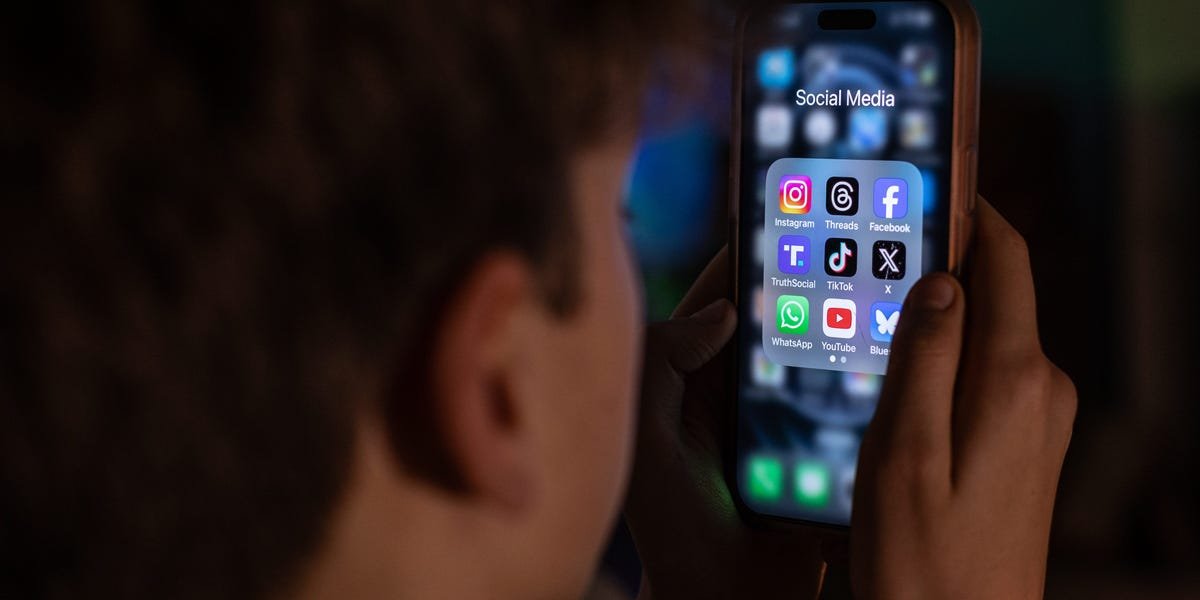
After years of discussion, 2026 is shaping up to be the year when governments around the world take action on kids using social media.
Australia, France, Denmark, and Norway are advancing or planning social-media bans for young people under a certain age. In the US, a patchwork of state-based efforts is likely to face tougher prospects.
The changes come as concerns mount over the toll that platforms like TikTok, YouTube, and Snapchat can take on young people’s mental health.
French President Emmanuel Macron, in a New Year’s Eve speech, reiterated his support for banning social media for children and young teens — setting the tone for what could be a landmark year for such efforts worldwide.
“We will protect our children and teenagers from social media and screens,” he said.
Social media ban talk becomes action
World leaders have talked for years about restricting children’s access to social media. Now, that talk is crystallizing into action. Australia became the first major nation to impose a social-media ban for children under 16. Its law took effect in December.
Macron wants France to follow Australia’s example. Bills in the works would restrict access for children under 15 starting next fall, timed to coincide with the start of the new academic year.
The Malaysian government has said it intends to implement a similar ban this year. Denmark is also planning a ban for children under 15, Prime Minister Mette Frederiksen announced in October, warning that “never before have so many children and young people suffered from anxiety and depression.” Norway, too, is considering similar measures, though its prime minister acknowledged it would be a challenge to enforce.
In India, high court judges suggested in December that the country consider legislation modeled on Australia’s approach.
Social media companies say the measures are too extreme
Social media executives have criticized bans on their products, touting their own safeguards, questioning the feasibility of such measures, and warning of unintended consequences.
As for the Australian law, Google and Meta had both called for a delay in its implementation. They said the government should rely on an age-verification system, which had been under trial before the new law took effect.
“We want young people to have safe, age-appropriate experiences online and have spent a decade developing more than 50 tools and policies designed to protect them,” a Meta spokesperson told Business Insider last year in response to EU discussion on young people and social media.
Elon Musk, owner of X, criticized Australia’s legislation, calling it “a backdoor way to control access to the Internet by all Australians.” TikTok expressed “significant concerns” with the legislation.
A complicated patchwork in the US
Meanwhile, a nationwide effort in the US — the birthplace of the world’s largest social media companies — faces an uphill battle.
While lawmakers in Congress have floated proposals to restrict young people’s access, none have passed. Instead, the push has largely shifted to the states, where a patchwork of age-verification rules, parental-consent laws, and time limits is advancing, often amid legal challenges.
Virginia is set to impose a one-hour daily limit on social-media use for children under 16 unless parents opt out, a law that is scheduled to take effect this year but is already facing legal challenges. Nebraska recently passed legislation requiring parental consent for minors to open social-media accounts. Other states, including Utah and Florida, have advanced age-verification or parental-consent laws that have been delayed or blocked in court.
Some states are targeting smartphones, rather than just social media, imposing “bell-to-bell” bans on cellphones at public schools.
Attorneys general from 14 states sued TikTok in October, saying the app is addictive and profits from damaging the mental health of children. TikTok has disputed that its products harm kids, defending its own internal safeguards.
While momentum is gathering for efforts to protect children from social media, some industry watchers have cautioned that such efforts aren’t a magic fix and could have unexpected knock-on effects.
“While UNICEF welcomes the growing commitment to children’s online safety, social media bans come with their own risks, and they may even backfire,” UNICEF, the United Nations agency focused on children, said in a December statement, noting that some marginalized children rely on social media and that others may find workarounds or flock to darker corners of the internet.
