


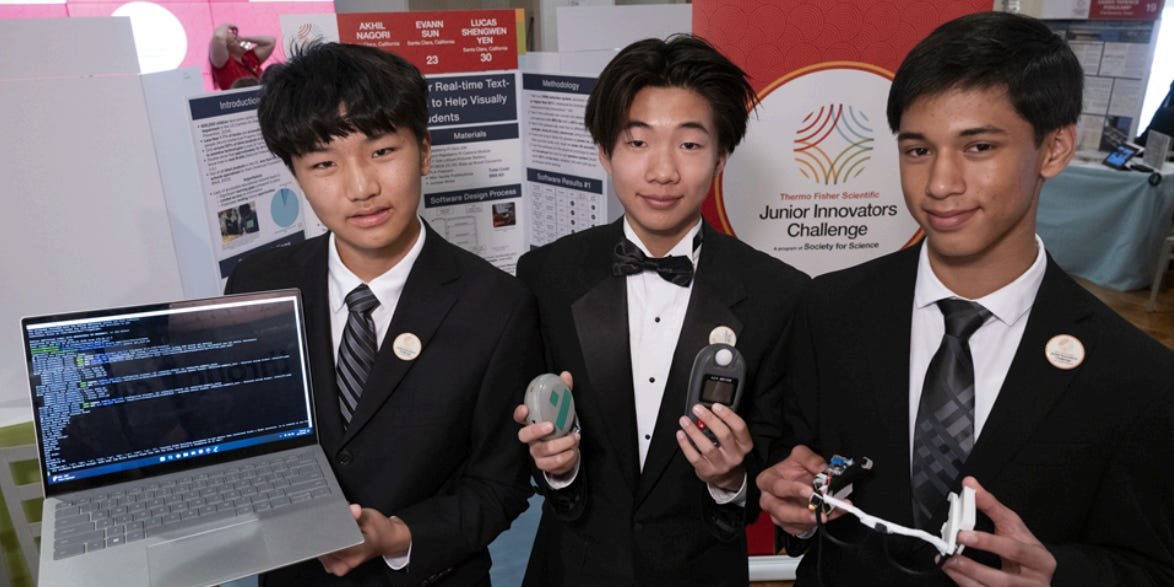
Tech companies in Silicon Valley are raising billions to develop wearable AI-powered products. A trio of teenagers in nearby Santa Clara built theirs for less than $100.
Akhil Nagori, Evann Sun, and Lucas Shengwen Yen, all of them 15 years old, invented wearable glasses powered by AI that translate text to speech in real time.
“Our main goal was to create an easy, cost-efficient way to transcribe text from any format for visually impaired students,” Nagori told Business Insider.
Nagori, Sun, and Yen submitted their prototype, which took about five months to complete, to the Thermo Fisher Scientific Junior Innovators Challenge in October and won a $10,000 award.
Akhil Nagori
The boys said their prototype has over 90% accuracy when translating text to speech. The glasses are designed to take pictures, extract the text, and convert the text to audio played through tiny speakers built into the glasses frames.
“One of the most important aspects of our project is the load time,” Yen said. “And that averaged around 13 seconds.”
The idea to build AI-powered text-to-speech glasses came after Nagori traveled to India to visit family, including his great-uncle who is visually impaired and works as a cashier.
“He has all these boxes filled with these braille receipts. He has to go through them line by line,” Nagori said. “When I saw that, I said, ‘There’s got to be an easier way that’s not so tedious.'”
Sun, Nagori, and Yen used 800 images to train their software
To create the glasses, the boys had to clear three hurdles: hardware, software, and collecting data through testing. Sun said they designed the glasses frames with Fusion 360, a CAD software, and used a 3D printer.
“We found the average glasses dimensions for middle to high school students,” Sun said. “Since we’re trying to have all of the components on the glasses, we had to custom-design the areas for all of them.”
The glasses contain a camera, battery, speakers, and a small computer board called a Raspberry Pi. They also have a tiny on-and-off switch.
“We want students to use this for, give or take, the entire school day,” Sun said. “We are really concerned about the battery life, especially when we are using such a small battery.”
For software, Nagori said they custom-trained a convolutional recurrent neural network, or CRNN, on a dataset of 800 images collected from school textbooks and other education materials. They ensured that the model was trained on colorful images and different types of fonts, which are often characteristic of textbooks.
Akhil Nagori
“We had to take those images ourselves in three different lighting conditions that mimicked classroom, low lighting, and outdoor lighting,” Nagori said.
Collecting data on their prototype involved conducting many test rounds.
“After all our hardware and software were done, we tested our software part,” Sun said. “We would input images that we saw online or that we took ourselves into our software model. Then, it extracted the text and gave us an MP3 file, which we could use to improve our accuracy.”
Nagori, Sun, and Yen’s prototype ultimately gained national recognition, but their journey wasn’t without challenges.
“We had a lot of all-nighters,” Nagori said.
At one point, Yen said the glasses underwent a serious defect hours before they were scheduled to present the prototype at the science competition.
“On the flight there, some of our soldering came off the Raspberry Pi. Without the soldering, nothing worked, and the glasses wouldn’t start up. We were all in panic mode,” Yen said. “The night before we were presenting, my dad ran to the closest mechanic store and got a soldering iron. The three of us put on masks, hunched over, and fixed it.”
Scaling up
The Thermo Fisher Scientific Junior Innovators Challenge is a top STEM research competition for students, so receiving recognition is a notable achievement.
To qualify, middle school students must compete at a local science or engineering fair, where judges nominate the top 10% of projects. About 2,000 of those winners apply to compete at the national competition, but only 300 are selected. From there, judges whittle the number down to 30 applicants, who present their research and complete challenges in Washington, D.C.
Society for Science
In addition to the $10,000 prize the boys won for the glasses, Nagori also earned the Thermo Fisher Scientific Leadership Award. Sun received $10,000 for the Lemelson Foundation Award for Invention.
Winning at the competition meant a lot to Nagori, Sun, and Yen, who initially didn’t receive a nomination. However, judges from the state level attended the boys’ competition and recognized the value in their research.
“I think it really taught us that even if we don’t get what we want the first time, as long as we work hard and stay committed, we can come back and be better,” Sun said.
Their research is still in the prototype phase, but they have ambitious plans to expand. Nagori said they received a $,5000 grant to scale their glasses, which will help them reach more of their community.
“We’re currently working on implementing a lot of our glasses throughout California,” Nagori said. “We have a big 3D printer in my garage right now with 30 Raspberry Pis, 30 cameras, 30 batteries.”
