


The US is light years behind its adversaries in military drone production. A San Diego startup wants to help solve that problem by bringing 3D printers to the battlefield.
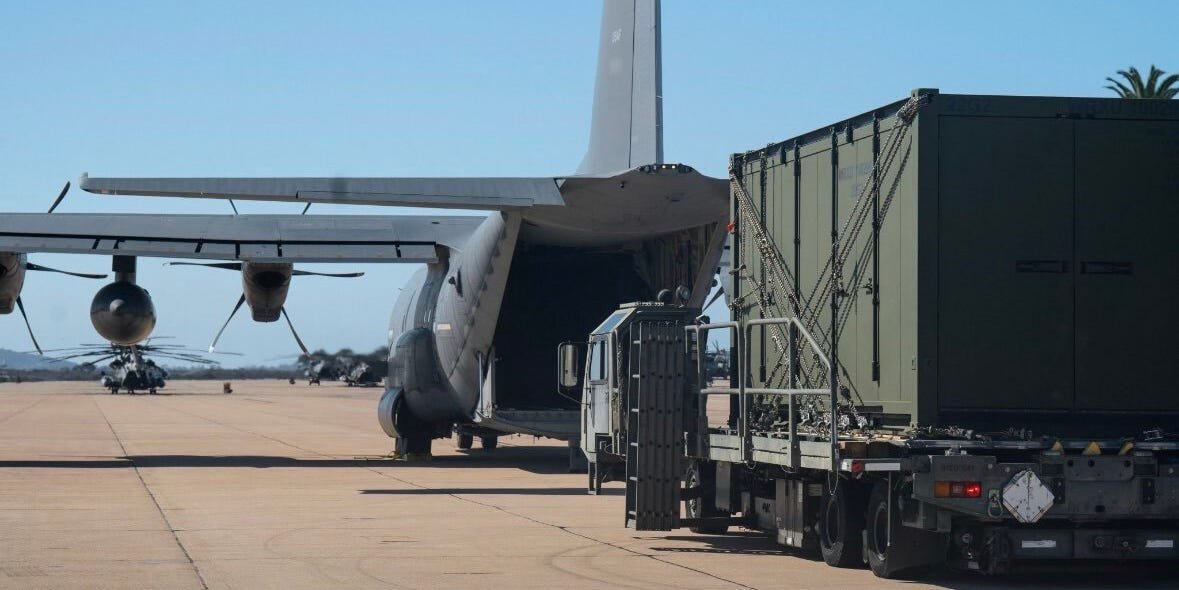
Firestorm Labs has designed a small, mobile factory that the company says can fabricate virtually any model of drone or drone part. Each factory consists of two 20-foot shipping containers, outfitted with industrial-grade HP printers. Set-up requires just two to four people, and the company estimates that each factory can currently churn out about 17 small-to-mid-sized drones drones per week. The company also has two of its own drone designs.
Defense Secretary Pete Hegseth has challenged the tech industry to help the US catch up on drones, and Silicon Valley is eager to cash in. Firestorm last year won a $100 million Air Force contract to research and develop unmanned aerial systems. This year, it raised $47 million in Series A funding from New Enterprise Associates, Lockheed Martin Ventures, and others.
This story is part of a series on the major players in the US drone industry. See more in our series:
Homing in on drones
Chad McCoy, cofounder and chief growth officer at Firestorm, served in the military for 23 years as a pararescueman, a medic trained to jump from aircraft and rappel down mountains to rescue service members or civilians in perilous situations.
One of the pieces of equipment he sorely needed was a small, waterproof box with a single plug to power his medical devices. It took four years for the military to develop and procure it, McCoy said in a 2023 podcast interview. Now, he wants to help the military iterate and produce things faster.
“Logistics is the way we win wars,” McCoy told Business Insider. “And if we’re able to empower the soldiers and sailors and Marines at the forward edge of the battle, it completely changes the game.”
Chinese companies, led by market leader DJI, make tens of millions of drones per year, according to Bobby Sakaki, chief executive of UAS Nexus, a drone industry consultant. As the US races to ramp up its drone capabilities, one big challenge is a lack of parts for the type of drones being used on the battlefield, he said.
When Firestorm co-founders Dan Magy and Ian Muceus pitched McCoy on joining their company a few years ago, they proposed making cheap cruise missiles that could be built in mass quantities. Magy had founded Citadel Defense Company, which made counter drone technology and was acquired in 2021 by BlueHalo. Muceus had worked in aerospace and defense manufacturing at Origin, a 3D printing startup that was acquired by 3D printing company Stratasys.
McCoy, Magy, and Muceus eventually settled on creating a manufacturing solution for drones, which were becoming ubiquitous on the battlefield in places like Ukraine.
It was a fortuitous choice. Hegseth last week announced a plan to solicit bids from US companies to manufacture hundreds of thousands of inexpensive, unmanned drones over the next two years. The Pentagon plans to spend $1 billion on the initiative.
“We cannot be left behind,” Hegseth said in a Defense Department video posted on YouTube.
For Firestorm, one challenge could be convincing the Pentagon to use drones made out of nylon instead of materials like steel and carbon fiber. The startup may also have to adjust its move-fast mentality to the reality of working with the federal government. Hegseth has said he wants to speed up the Pentagon’s notoriously slow acquisition process.
Firestorm Labs
A go-anywhere factory
Firestorm’s pitch is that its mobile manufacturing facilities could help the US reach its drone ambitions.
“If we could create weapons anywhere in the world,” McCoy said, “that would be a massive force multiplier.”
Firestorm’s mobile factory is called xCell. The sides of each shipping container pop out to create more space inside. The facility is designed to work in a range of climates; the company has tested its HVAC systems in arctic conditions in northern Canada, McCoy said.
Firestorm has a handful of xCells in the US. The company says that by the first quarter of 2026, it will have one stationed somewhere in the US Indo-Pacific Command, a vast area stretching from the west coast of the US to India and from Antarctica to the North Pole.
Firestorm’s two drone designs, called Tempest and Hurricane, are customizable with open software development tools.
Eventually, McCoy hopes xCell can print more than just drones, perhaps venturing into prosthetics or medical devices.
“I think we can change how combat is fought and how logistics are done,” he said.
Have a tip? Reach Julia at jhornstein@insider.com or securely on Signal at juliah.22. Use a personal email address, a nonwork device, and nonwork WiFi. Here’s our guide to sharing information securely.
