


Tech CEOs can’t stop talking about data centers in space.
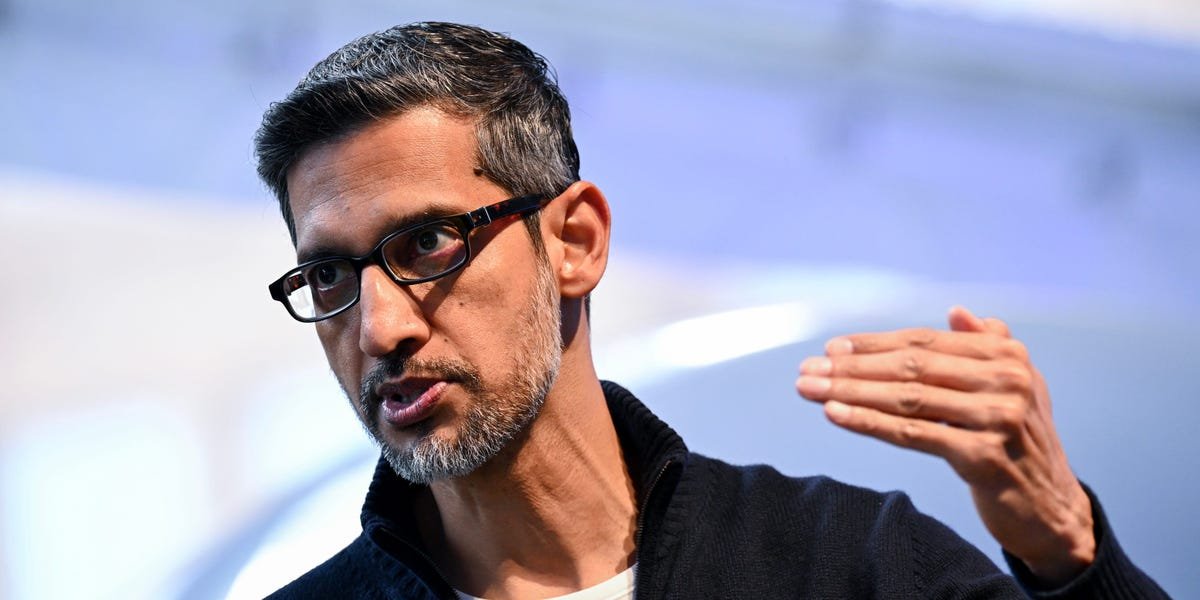
“Obviously, it’s a moonshot,” Google CEO Sundar Pichai said on the “Google AI: Release Notes” podcast this week.
He acknowledged that the notion seems “crazy” today, but “when you truly step back and envision the amount of compute we’re going to need, it starts making sense and it’s a matter of time.”
Pichai was referring to Project Suncatcher, a new long-term research bet that Google announced in November. The goal of Project Suncatcher is to “one day scale machine learning in space,” according to a company blog post.
The Google CEO didn’t offer much in the way of details, except that “in 2027, hopefully we’ll have a TPU somewhere in space,” he said, referring to the company’s custom AI chip.
“Maybe we’ll meet a Tesla Roadster,” he quipped.
Pichai was referring to the time when Elon Musk hitched his old Tesla Roadster onto a SpaceX rocket and blasted it into orbit with a spacesuit-clad dummy perched in the driver’s seat. Launched in 2018, the roadster was still in deep space as of earlier this year, when astronomers mistook it for an asteroid.
SpaceX
That Roadster stunt doesn’t begin to compare with the outer space ambitions of Musk and other tech titans in the age of AI.
“Starship should be able to deliver around 300 GW per year of solar-powered AI satellites to orbit, maybe 500 GW. The ‘per year’ part is what makes this such a big deal,” Musk wrote in an X post earlier this month.
The numbers Musk is talking about represent an unprecedented amount of electric capacity. Global data center capacity is currently 59 gigawatts here on Earth, Goldman Sachs said earlier this year.
Global electricity demand is on track to double by 2050, in part due to the race to build AI data centers. In the US, data centers are the biggest driver of the surging demand that is straining the country’s power grid.
Musk, Pichai, and other tech leaders — Jeff Bezos is predicting that data centers will go to space in the next 10 to 20 years — know that the amount of demand coming from AI data centers might not be tenable.
“I do guess that a lot of the world gets covered in data centers over time,” OpenAI CEO Sam Altman told comedian and podcaster Theo Von in a July interview. “But I don’t know, because maybe we put them in space. Like maybe we build a big Dyson sphere on the solar system and say, ‘Hey, it actually makes no sense to put these on Earth.'”
It’s a question that could explain why some of tech leaders seem so eager to send data centers to space, where, as Salesforce CEO Marc Benioff pointed out in a recent tweet, there is “continuous solar and no batteries needed” for power and cooling.
“The lowest cost place for data centers is space,” Benioff wrote in a post on X earlier this month, referring to a video clip of Musk touting the benefits of orbital AI at the US-Saudi Investment Forum earlier this month.
“The sun only receives roughly one, two billionth of the sun’s energy,” Musk said at the event. “So, if you want to have something that is, say, a million times more energy than Earth could possibly produce, you must go into space. This is where it’s kind of handy to have a space company.”
