


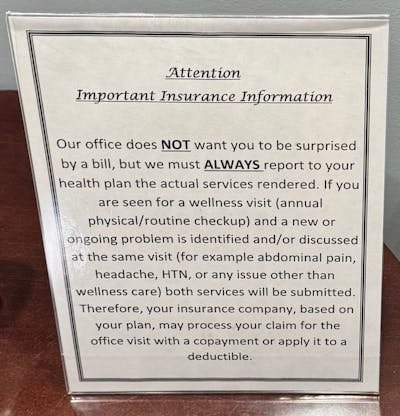
Have you ever noticed a sign in a doctor’s office saying that you may have to pay extra insurance costs if you discuss additional problems with your physician?
If so, you’re not alone. As health care spending continues to rise, providers are being asked to warn patients about any potential unexpected costs – for example, insurance charges for additional services at an otherwise fully covered annual wellness visit.

The sign that inspired it all. Helen Colby
But our research shows these warning signs could have an unintended consequence, discouraging patients from speaking openly with their doctors.
We are professors who research how people make spending decisions and were inspired to study this issue by real signs at a university-affiliated health care office. Other researchers have found many reasons why people hesitate to speak openly with their doctors, and we wondered whether these signs might be another factor. So we conducted some experiments.
In two studies, we found that when people saw an insurance warning sign, they were less willing to raise a wide variety of issues during a physical exam. These included both short-term issues such as headaches, fatigue and arthritis pain in the finger joints, and previously diagnosed, chronic conditions including high blood pressure, Type 2 diabetes and asthma.
In a third study, we tested whether it was what the sign said – or just the mere presence of a sign mentioning costs – that made people reluctant to speak up. We showed participants either no sign, an insurance warning sign, or a sign about a prescription drug discount program, which was also modeled after a real sign in the same doctor’s office. Only people who saw the insurance sign were less likely to speak up.
Why it matters
Frank conversations between patients and providers are essential for good health care. They allow providers to tailor medications, reduce side effects and find treatments that are right for each patient. What’s more, treating issues earlier rather than later generally leads to better outcomes and costs less in the long run.
We found that insurance warning signage, no matter how necessary or well intended, can discourage patients from sharing important health information. This could cause delays in important care, leading to unnecessary discomfort and stress as patients suffer with untreated issues.
Health care offices need to include certain insurance disclosures to inform patients of their rights under the No Surprises Act, which took effect in 2022. However, providers and administrators should be aware that their patients may often have cost concerns.
Doctors’ offices can try to find ways to communicate potential insurance costs while also encouraging patients to have open and honest discussions with their providers. The signage at the office that inspired this work had many words bolded and underlined, which may have made it feel especially aggressive to some patients.
It’s important for patients to know that they should never ignore symptoms. In fact, raising a concern as early as possible with a doctor or another health care provider can save more money down the road.
What still isn’t known
We weren’t able to study the long-term impacts of such signs, and it’s possible they have even more negative effects than we uncovered – for example, by making patients reluctant to have annual wellness visits.
It’s also unclear how often health care professionals actually report such conversations to insurers, especially when the issues are brought up briefly during a checkup and don’t require additional testing or treatment at that time.
But the research is clear on one point: When patients feel they can speak freely to their doctors, they get better care. That’s why doctors and other health care professionals should be aware that even well-intended warning signs may encourage patients to keep silent.
The Research Brief is a short take on interesting academic work.
This article is republished from The Conversation, a nonprofit, independent news organization bringing you facts and trustworthy analysis to help you make sense of our complex world. It was written by: Helen Colby, Indiana University; Deidre Popovich, Texas Tech University, and Tony Stovall, Indiana University
Read more:
Deidre Popovich has received grant funding from BlueCross BlueShield of Texas and Providence Health.
Helen Colby and Tony Stovall do not work for, consult, own shares in or receive funding from any company or organization that would benefit from this article, and have disclosed no relevant affiliations beyond their academic appointment.
