


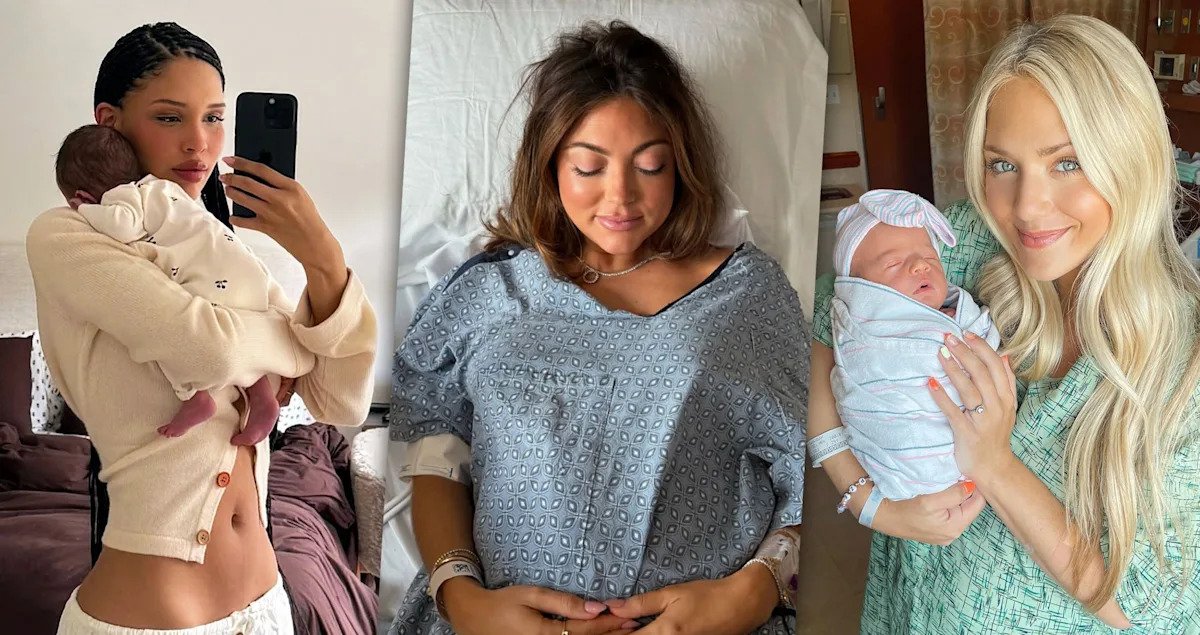
The pregnant and postpartum women who pop up on my Instagram feed are always luminous. These new mothers, some of them full-time influencers and boasting millions of followers, seem barely changed by the radical transformation of pregnancy and birth. They pose from their hospital beds with hair and makeup perfectly done (like Savannah LaBrant, who has 7 million Instagram followers). They make videos while in labor, dancing to trending songs, apparently unbothered by the daunting task that lies ahead of them (like Campbell Puckett, who has 1.4 million Instagram followers). After giving birth, they bounce back immediately, holding their newborns while showing off impossibly flat stomachs (like Nara Smith, who has 4.8 million Instagram followers).
Smith became a viral sensation in 2023 by helping to pioneer the “tradwife” aesthetic. Although she never labeled herself as such, she posted elaborate cooking videos in which she painstakingly makes everything — like chewing gum, Cinnamon Toast Crunch and bagels — from scratch, almost daring viewers to get mad at her outlandish homemaking.
Smith continues to grace the upper echelons of mom influencer royalty. The content she’s posted in the last month after giving birth to her fourth child, a daughter named Fawnie Golden, on Sept. 27, shows an almost ludicrously fantastical depiction of the postpartum experience.
In an Instagram reel she labeled as being filmed eight hours after giving birth, viewed over 29 million times, Smith cracks an ice pack and shows the postpartum diaper she’s wearing. Alongside a jaunty jazz soundtrack, Smith does her skincare routine and cuddles with her newborn. In a video posted just 3 weeks after giving birth, Smith makes roasted butternut squash soup (with homemade garlic algae oil, she notes) and focaccia bread, all while wearing a delicate, strapless white dress. At four weeks postpartum, she posted a series of two photos in which she cuddles her newborn with her cardigan open to show her chiseled stomach. “Women’s bodies are purely magic,” the caption reads. “Divinely designed to create, grow and nurture life.”
In the thousands of comments under Nara’s pictures, users are torn. On one side, there are the people who believe Smith should be able to celebrate her body in any way she sees fit; on the other side, there are hundreds of comments from women stressing how damaging it is for an influencer as popular as Smith to showcase such an unrealistic body standard mere weeks after birth.
Many women struggle with body image issues in the postpartum period and body image dissatisfaction is a risk factor for postpartum depression. Though the pressure to “snap back” postpartum isn’t new — celebrities’ post-baby bodies have long been a subject of fascination — there’s something different about watching influencers snap back. They can feel more like normal people than celebrities do, with snapshots of the mundane moments of their lives constantly beamed to you through your phone. When I saw Princess Kate posing prettily on the hospital steps days after giving birth, I thought, Well, she’s a princess. But when you see an influencer doing the same, it feels closer to home — and more like something you should be capable of attaining.
The mom influencers whose content I consumed before I was a mother myself made the postpartum period look almost cozy. Through their eyes, the weeks following birth looked like a time of rest. These new moms were sleep-deprived, sure, but charmingly so, and they were never too tired to create content. The women that I saw bounced back immediately, going out to dinner with their husbands just days after giving birth. They made homemade meals with their infants strapped to their chests. They were not only functional but aspirationally so.
When Kellyanne Toll, a 32-year-old mother of three, had her first baby, she expected the ideal postpartum experience that mom influencers seemed to have promised her. “I just thought that if I got organized, if I bought the things they had, it would make postpartum so much easier,” she said. “We would have all these cozy sessions on the couch and matching outfits coming home from the hospital.”
The reality of postpartum life, says Toll, who recently gave birth to twins, was “complete chaos.” She didn’t spend her time cozily cuddling her babies on the couch; they didn’t come home from the hospital in matching outfits. “I’m like, ‘Oh I’ve tried for almost three hours to get one of the babies down for a nap today. I didn’t brush my teeth until 4 o’clock. My hair has been in a bun for two days.’”
Still, the idealistic images about motherhood many of us are bombarded with on social media has a way of insidiously infiltrating your psyche. When I was packing my bag to go to the hospital for my scheduled induction, I brought my creams and serums with me because I had seen so many videos of moms doing their skin care routine in the hours after birth. I packed my makeup bag, thinking I would put myself together during labor so I would have the perfect photo of my daughter and me after she was born. I literally cover internet culture for a living and wrote an entire book — Like, Follow, Subscribe: Influencer Kids & the Cost of a Childhood Online — about the reality behind the shiny veneers of mom influencers and family vloggers, and still I expected my postpartum experience to be prettier than it was.
After being put under general anesthesia for an emergency C-section, it’s safe to say that I didn’t do my makeup during labor. In the five days I stayed in the hospital after my daughter’s birth, I never once touched my moisturizer.
Mallory Brooks, a 27-year-old mother of one, went on an unfollowing spree while she was in the early postpartum period. “I fantasized about having a life that looked a lot like theirs,” she says of the mom influencers dominating her feed. “My life looked the complete opposite. I compared the way I looked. I compared everything about the motherhood experience, and it just made me feel terrible. I was not inspired. I was not encouraged. I could not relate.”
Brooks ultimately came to understand that, at their core, mom influencers are salespeople. When a mom influencer posts a beautifully posed picture of themselves and their newborn baby, it’s often accompanied by a link to their Amazon Storefront, where they earn a commission if you buy the products they’re featuring. Brooks likens it to a car salesman. “Like, maybe this car is really great, but at the end of the day, it’s their job to sell me this car. They’re going to say what they need to say, and they’re going to paint the picture they need to paint in order for me to buy the car.”
In the momfluencer world, the product that’s being sold is their picture-perfect version of motherhood. The promise is potent: If you only buy the swaddle linked on their Amazon Storefront, your baby will sleep through the night. If you use their discount code to buy their favorite moisturizer, your postpartum skin will also glow.
In the momfluencer world, the product that’s being sold is their picture-perfect version of motherhood.
Sara Louise Petersen, author of Momfluenced: Inside the Maddening, Picture-Perfect World of Mommy Influencer Culture, says she wasn’t particularly shocked when she saw Smith’s photo of her washboard abs just weeks postpartum. “There’s nothing surprising (for me) about an influencer whose bread and butter is shock and awe sharing a postpartum photograph that is bound to trigger a response of shock and awe,” she says.
But where does that leave regular moms who are holding themselves to impossible standards? “It makes you feel like you’re failing,” says Kellyanne, the mother of three. “I think a lot of women secretly feel like they’re failing, like they’re not keeping up as well as other moms, when in reality, I don’t think anybody is.”
In a TikTok viewed over 2 million times, Ari Taylor, a 24-year-old mother, made a response to Smith’s video. In it, she lip-syncs to audio that says, “I’m done. Cut the show, I’m done.” Her hair is in a messy, lopsided bun, and a breast pump is peeking out from under her shirt. “Nara Smith and I are both 25 days postpartum … just living very different realities,” the text reads.
In an interview with Yahoo, Taylor said, “Seeing that post, being the same frame postpartum as her, I was like, be so for real. It’s just so unattainable and unreachable.”
Taylor’s TikTok features comments like ‘I can barely get to 1 load of laundry and she’s making a 2-3 hour meal lol’ and ‘All I did was cry my first 3 weeks both times’. (Same.) “It made me feel heard,” Taylor says. “It can be hard not to compare, [so] it was nice to relate to other moms that are going through postpartum and feel the same way.”
