


(This is an excerpt of the Health Rounds newsletter, where we present latest medical studies on Tuesdays and Thursdays.)
By Nancy Lapid
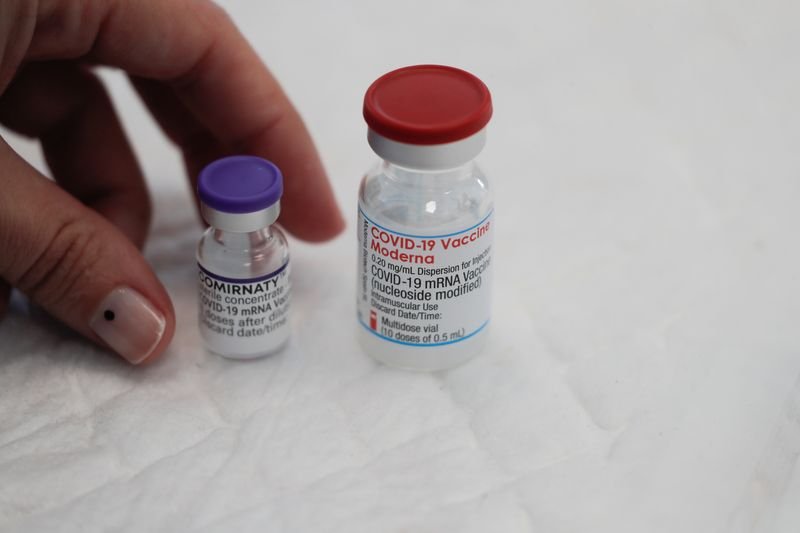
(Reuters) -Cancer patients who received mRNA-based COVID vaccines within 100 days of starting treatment with widely used immunotherapies were twice as likely to be alive three years after beginning treatment, researchers reported.
Among 180 such patients with advanced non-small cell lung cancer who received an mRNA-based COVID vaccine from Moderna or Pfizer/BioNTech, the median survival, or the point at which half the patients had died, was 37.33 months. Among 704 cancer patients who did not receive an mRNA COVID shot, median survival was 20.6 months.
Among patients with metastatic melanoma – the most deadly form of skin cancer – half of the 167 patients who did not receive a vaccine had died by 26.67 months. Of the 43 melanoma patients who did receive a vaccine, more than half were still alive and so median survival could not yet be calculated.
“The really exciting part of our work is that it points to the possibility that widely available, low-cost vaccines have the potential to dramatically improve the effectiveness of certain immune therapies,” study coauthor Dr. Adam Grippin of The University of Texas MD Anderson Cancer Center in Houston said in a statement.
U.S. Health Secretary Robert F. Kennedy Jr. has publicly questioned the safety and efficacy of vaccines, including those using mRNA technology, contrary to scientific evidence.
In earlier laboratory experiments, researchers had observed that mRNA vaccines improve the effectiveness of cancer drugs such as Merck’s Keytruda, known as immune checkpoint inhibitors, in part by inducing the cancer cells to increase production of the same PD-L1 protein that the drugs are designed to recognize and block.
In fact, the survival improvements in the current study were most pronounced in patients with tumors that were not likely to respond well to immunotherapy because of low production of PD-L1. These patients experienced a nearly five-fold improvement in three-year overall survival rates with receipt of a COVID vaccine, researchers reported at the 2025 European Society for Medical Oncology Congress in Berlin.
The findings were consistent even when considering independent factors, such as vaccine manufacturer, number of doses, and when patients received treatment at MD Anderson.
“We are hopeful that mRNA vaccines could not only improve outcomes for patients being treated with immunotherapies,” said Grippin, “but also bring the benefits of these therapies to patients with treatment-resistant disease.”
Retinal implant reverses common age-related blindness
An experimental device implanted in the eye and wirelessly connected to special eyeglasses reversed a common cause of blindness in the majority of patients tested in a small study, researchers reported at a medical meeting.
Among 32 older volunteers who were legally blind due to age-related macular degeneration (AMD) and who received Science Corp’s PRIMA System implant, 80% were able to read letters, numbers and words soon afterward and at an exam performed a year later.
The average improvement was about 25 letters on the standard eye chart, researchers said at the American Academy of Ophthalmology meeting in Orlando, Florida.
The implant system includes special glasses and a pocket processor with zoom functionality and other digital enhancements that brought even small print – fonts smaller than 8 points – into focus, researchers said. Details of the study were also published in The New England Journal of Medicine.
In AMD, blind spots appear in the center of the patient’s vision, while peripheral vision remains unimpaired. The PRIMA implant restored patients’ central vision while maintaining their natural peripheral vision, researchers said.
“The fact that they see simultaneously prosthetic and peripheral vision is important because they can merge and use vision to its fullest,” study coauthor Dr. Daniel Palanker from Stanford University said in a statement.
A camera on the glasses captures an image and sends the visual information to the pocket processor. Processed information is then returned to the glasses and projected onto the implant with near-infrared light. The implant converts the infrared light into electrical impulses that stimulate the patient’s few remaining functional retinal cells, which then pass the signal to the optic nerve.
Nineteen patients experienced side effects like pressure in the eye, retinal tears, and blood under the retina. Most were mild or moderate and resolved within two months.
“The benefits far outweighed the adverse effects,” said senior author Dr. José-Alain Sahel from the University of Pittsburgh School of Medicine. “This is the first time that a system has enabled patients who have lost their central vision to read words and even sentences again, while preserving their peripheral vision.”
AMD affects nearly 5 million people globally and is responsible for around 20% of all cases of legal blindness in North America.
Science Corp has applied to regulators in Europe and the U.S. for approval of the implant system.
(To receive the full newsletter in your inbox for free sign up here)
(Reporting by Nancy Lapid; additional reporting by Shawana Alleyne-Morris; Editing by Bill Berkrot)
