


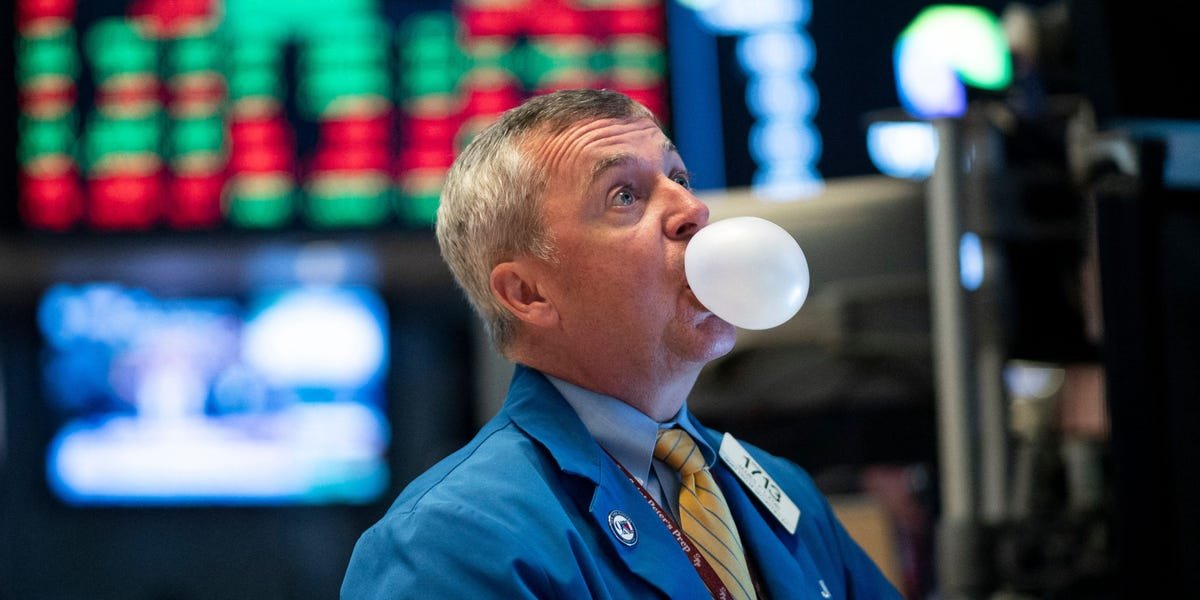
The markets may be fretting about an AI bubble, but Goldman Sachs says the boom is still in its opening act.
That’s because the scale of current investment remains small compared with the potential economic payoff, analysts at the Wall Street giant argue.
“The enormous economic value promised by generative AI justifies the current investment in AI infrastructure and overall levels of AI investment appear sustainable as long as companies expect that investment today will generate outsized returns over the long run,” wrote analysts at Goldman Sachs in a Wednesday note.
The bank’s analysts pointed to two main reasons for their call: AI applications are already delivering productivity gains where they’re deployed, and unlocking those gains requires massive computing power.
Goldman estimates that the long-term value created by AI productivity far exceeds its upfront costs. The firm projects that widespread AI adoption could add $20 trillion to the US economy, with about $8 trillion of that flowing to companies as capital income.
“Generative AI still appears set to deliver a rapid acceleration in task automation that will drive labor cost savings and boost productivity, with our baseline estimates suggesting a 15% gross uplift to economy-wide US labor productivity following full adoption, which we expect will realize over a 10-year period,” the analysts wrote.
AI investment is modest by historical standards
Despite record-breaking spending on chips, servers, and data centers, Goldman says AI investment is modest by the standards of past technology revolutions.
The firm estimates that AI-related investment in the US is under 1% of GDP, compared with the 2% to 5% of GDP reached during earlier technology booms, including the railroad expansion, the electrification wave of the 1920s, and the dot-com era of the late 1990s.
Goldman’s analysts said they still see the macroeconomic justification for AI investment as compelling and are “less concerned about the dollar amount of AI capex.” They noted that roughly $300 billion is being spent annually in 2025 — a scale they view as appropriate given the technology’s long-term potential returns.
The winners may not be today’s biggest spenders
Still, Goldman acknowledges “valid concerns” about whether the companies pouring the most money into AI will ultimately reap the rewards, especially given hardware’s rapid depreciation.
Related stories

Business Insider tells the innovative stories you want to know
Business Insider tells the innovative stories you want to know
The analysts argue that timing matters less if investors can capture an outsize share of AI’s long-term economic value. But history suggests that being first doesn’t always mean finishing best.
“First movers” could fare poorly in infrastructure buildouts, they wrote, citing railroads and telecommunications as examples. In many cases, later entrants captured better returns by acquiring assets cheaply after an early overbuild.
That dynamic could repeat in the AI era.
“The current AI market structure provides little clarity into whether today’s AI leaders will be long-run AI winners,” they wrote.
“First-mover advantages are stronger when complementary assets (e.g., semiconductors) are scarce and production is vertically integrated—suggesting that today’s leaders may outperform—but weaker in periods of rapid technological change like today,” they added.
Early adopters are also hedging their bets by using multiple AI models instead of sticking to one ecosystem, which could weaken incumbents’ advantages, the analysts said.
They added that it’s difficult to pinpoint when the motivation to keep pouring money into AI will fade, since early productivity gains and steady improvements in model performance are still encouraging investment.
“So while investment should eventually moderate as the AI investment cycle moves beyond the build phase and declining hardware costs dominate, the technological backdrop still looks supportive for continued AI investment,” the analysts wrote.
Goldman’s assessment lands amid an intense debate about whether AI has inflated another tech bubble.
Last week, strategists at Morgan Stanley and Goldman Sachs argued that AI stock valuations aren’t as stretched as critics claim when factoring earnings growth, cash flow, and profit margins.
