


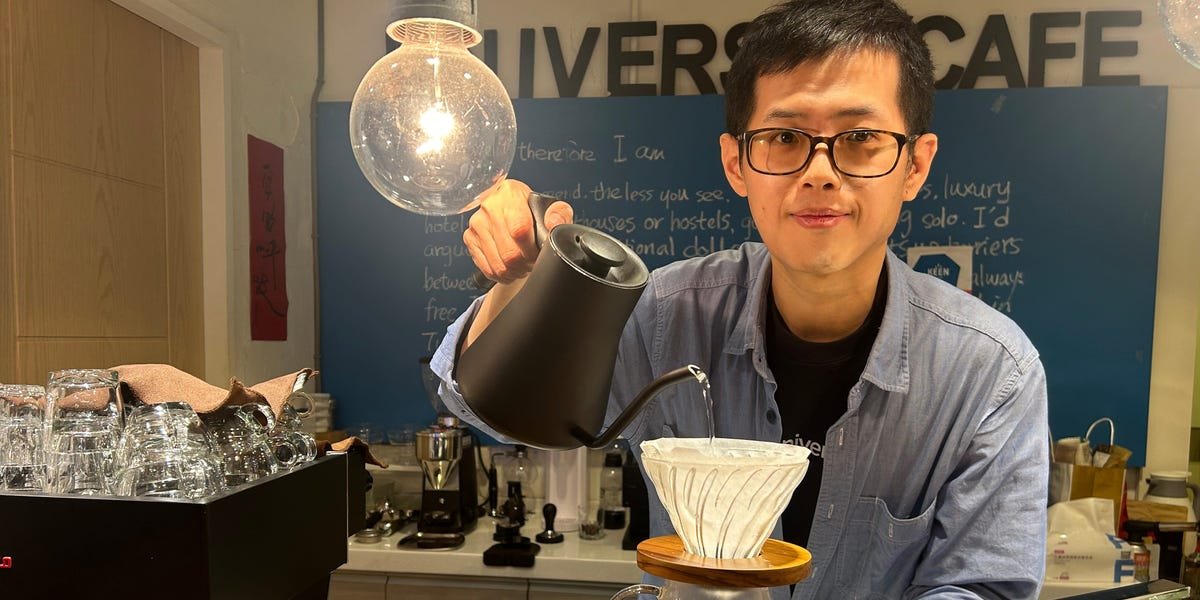
This as-told-to essay is based on a conversation with Nian Yang-yi, 34, a barista turned quality control specialist at a coffee trading firm in Taiwan. The following has been translated and edited for length and clarity.
I chose to study computer science and information engineering in college because I didn’t like interacting with people.
Programming seemed perfect: I could spend all day on a computer, coding and debugging. At the time, I was happy with this choice and imagined my future would follow that path.
But life is unexpected. In my third year of college, I had a sports accident that caused a retinal detachment. I went through surgery, and afterward, the doctor told me to rest and not overuse my eyes.
If I became an engineer right away, the pressure on my eyes would be even greater. So my plan was simple: work somewhere else for two or three years, let my eyes recover, and then return to writing code.
That’s how I ended up at a café. At first, I didn’t drink coffee at all, and I didn’t like it. But my boss and coworkers encouraged me to try it. They brewed me a cup every day.
At first, I refused, but eventually I tried a cup — and something clicked. It felt like coding: Could I make this more precise, more efficient? Could I describe what I tasted so others could understand?
So, I started studying sensory skills and how to communicate flavors. That was how I became absorbed in coffee.
Coffee became my life
I worked as a barista at that café for 10 years.
Outside of work, I was still involved in coffee — going to tastings, events, and classes.
At first, I thought coffee was straightforward — as long as I could brew drinks that customers enjoyed and my coworkers liked, it felt like I had already learned everything there was to learn.
Related stories

Business Insider tells the innovative stories you want to know
Business Insider tells the innovative stories you want to know
But once I started going out and experiencing more, I realized coffee is something you can never fully master. People often say the more you study a subject, the more you realize how little you understand — and that was exactly how I felt about coffee.
It was partly why I left the café to join a coffee trading firm. I had met the boss in a coffee course, and he asked years later if I wanted to try working there.
I felt I had to do it because coffee is not just about making drinks. It is a whole supply chain — farmers, importers, roasters — and I wanted to learn more.
I’m now in my third year as a quality control specialist.
Nian Yang-yi
In the café, my skills were in brewing and serving customers. But upstream, the needs are different: evaluating beans, checking consistency, and thinking about market demand.
When I moved, my salary dropped from nearly 50,000 Taiwan dollars a month, about $1,600, to about 35,000 Taiwan dollars. Now, I earn about 42,000 Taiwan dollars.
This job has broadened my perspective on the coffee supply chain. In my fourth month, I earned the internationally recognized Arabica Q Grader certification.
Coffee changed me
Coffee changed me as a person. I used to avoid human interaction, but being a barista meant I had to understand customers, chat, and connect with them.
At first, it was a big challenge. Conversations often dropped awkwardly. But over time, I developed ways to interact more comfortably, learned to listen, and sense how people were feeling.
In 2022, I started volunteering at a community café for Believe in Next Generation, a nonprofit, where I regularly serve as a barista when the café offers coffee for a donation.
The nonprofit is located in a military village, and some elderly residents would come early, wait for me, and smile when I arrived. They didn’t directly say they needed companionship, but I could feel it.
Sometimes, they stayed in the café and told me their life stories and memories, many from Taiwan’s martial law years or the Japanese colonial era.
This is one of coffee’s meanings: It gives people a chance to gather and share their stories.
Believe in Next Generation
Balancing reality
Some of my engineering friends have told me they envy me for turning my interest into a job — until the topic of salary comes up, because their salaries can be two to three times mine.
I have wondered whether I should continue doing what I want to do or return to a more practical job.
At this stage of life — from your twenties into your early thirties — many people are buying cars and houses. But coffee is the industry that makes me feel the happiest and most at ease.
Now, I live with my parents in New Taipei City and share a mortgage with my sister for our family home. I pay about 15,000 Taiwan dollars a month toward it.
To manage, I spend less on recreation, like traveling once every three or four years. Since coffee is also my hobby, most of my discretionary spending goes to coffee courses or activities.
I can usually save 10,000 to 15,000 Taiwan dollars a month.
I also look for ways to increase my income through side hustles, such as judging coffee competitions and teaching courses. These can add about 5% to 10% to my monthly income.
Some people choose high-paying jobs and use their salaries to fund hobbies. Others, like me, turned their passion into work, even with less money.
The first step is to imagine the kind of life you want, and then decide if your passion is strong enough to carry you there.
If I could start over, my choice probably wouldn’t change — it would still be coffee.
Do you have a story to share about trading your dream job for your passion? Contact Huileng Tan at htan@businessinsider.com.
