


Jennifer Choate’s pregnancy was uncomplicated — until it wasn’t. Two and a half weeks before her March 6, 2025 due date, the 27-year-old went to the emergency room at the University of Maryland Baltimore Washington Medical Center after experiencing headaches and high blood pressure.
Doctors thought Choate might be suffering from preeclampsia and induced labor. Her fiancée rushed to her side. Choate chatted with him and her care team as her labor progressed normally. Suddenly, she was struck with an excruciating pressure in her chest and head.
“It was not painful but it felt like someone was squeezing me as hard as they possibly could. I felt like my head was going to explode,” Choate said. She turned to Arianna Bortle, the labor and delivery nurse at her side. “I said, ‘Something has gone wrong. I don’t feel good.'”
Bortle had only been a nurse for 18 months but Choate’s statements made her hair stand on end. She immediately ran to get her superiors. As they re-entered the room, Choate’s heart stopped.
“She was talking to me, and then she wasn’t,” Bortle said. “She didn’t have a pulse.”

Jennifer Choate and her fiance before her delivery. / Credit: Jennifer Choate
What is an amniotic fluid embolism?
What Choate had experienced was an amniotic fluid embolism, doctors said. The condition is a “super rare obstetric event” when amniotic fluid enters a person’s bloodstream and “sets off a cascade of events” that causes “essentially all major organs of the mom’s body to shut down,” said Dr. Nicole Scott, an associate professor of clinical obstetrics & gynecology at Indiana University’s School of Medicine.
Doctors don’t know what causes the “life-threatening event,” Scott said. It occurs in about 1 in 40,000 U.S. births, according to the Cleveland Clinic. They usually happen shortly after a person’s water breaks, and have no warning signs, Scott said. Patients quickly decompensate, with the heart failing and other organs shutting down. The body’s clotting process malfunctions, causing intense bleeding. People may experience strokes and seizures.
About half of the women who have an amniotic fluid embolism die, according to Scott. The mortality rate for their babies varies depending on the stage of labor a person is in when the embolism occurs.
Survivors usually suffer lifelong complications, according to Scott. A lack of blood to the brain may leave a patient with long-lasting neurological issues, and blood clots can cause musculoskeletal issues. Some people are paralyzed. Doctors may need to perform a hysterectomy. Survivors also “have a significant amount of trauma,” Scott said.

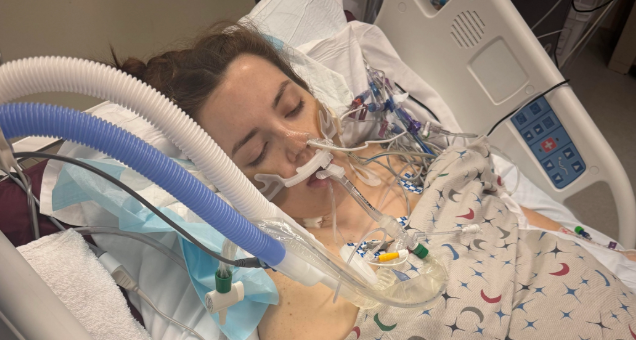
Jennifer Choate on a respirator after emergency surgery. / Credit: Jennifer Choate
A fight to recover
Choate was resuscitated, and her daughter was successfully delivered via cesarean section. Doctors used blood transfusions, clamps and a uterine tamponade to control Choate’s blood loss and stabilize her, said Dr. Pablo Argeles, the chair of obstetrics and gynecology at UM BWMC.
Medical professionals from multiple disciplines collaborated on how to keep Choate alive, Argeles said. She was placed on a ventilator and transferred to the University of Maryland Medical Center for advanced intensive care.
When Choate woke up, she had no idea what had happened or where her baby was. She assumed the worst.
“I was like, ‘If I have a tube in my throat, there’s no way she survived whatever happened … there’s no way that a baby that is measuring 7 or 8 pounds is alive right now,'” Choate said.
After an agonizing wait, Choate was told that her baby was alive and well. After a doctor explained what had happened, Choate understood that she was lucky: Both she and her daughter had survived, and she would not have long-term medical complications.

Jennifer Choate meets her baby. / Credit: Jennifer Choate
As Choate recovered, she was haunted by her ordeal. She Googled amniotic fluid embolisms and said she was horrified by the statistics she found. She was able to briefly see her baby but was distraught about missing so much time with her. Being apart hurt more than her recovery, she said.
“I was like, ‘I need to go home. I have to go home right now. I need to be a mom,'” Choate said. “They kept telling me I was a miracle. I was like, ‘I don’t care about being a miracle. I want to be a mom.'”
As staff weaned her off medications and machines, Choate began to push herself. She practiced how she would maneuver her way into the bathtub or stand up from a couch. She wheeled her baby’s bassinet around the recovery floor to show she was ready to leave.
“It was hard. It was the hardest thing I’ve ever done. It was painful, and I was crying. I was in so much pain. But when you have a baby, all of that pain just gets pushed to the side. My pain level was 1000 over 10, and I did not care,” Choate said.

Jennifer Choate pushes her baby in a bassinet while recovering. / Credit: Jennifer Choate
The display worked. Choate was discharged after nine days in the hospital.
“The one most important thing”
When Choate arrived home, the house was covered in so many cards, posters and baby gifts that she could barely recognize it. Her family offered support. Bortle, the nurse who realized something was wrong, came to visit. Her daughter, now seven months old, is on her best behavior, Choate joked, and practicing skills like rolling and sitting up.
“She doesn’t cry about literally anything. I say ‘She knows what I’ve been through, so she’s taking it easy,” Choate teased.
Even as life continues on, Choate said she thinks about her ordeal “every single day.”
“I’ve never taken my life for granted, but it is scary to think that anything can happen,” Choate said. “Sometimes I wonder, like, did this actually happen to me? I almost feel like I’m living in a different universe.”

Jennifer Choate, her fiance and their baby. / Credit: Jennifer Choate
Love for her daughter washes away those troubled thoughts quickly.
“I got the one most important thing out of my birth and labor,” Choate said. “My child is alive.”
“Matlock” star Skye P. Marshall opens up about her journey to success
New Monticello exhibit chronicles centuries-old political story
Exclusive discounts from CBS Mornings Deals
