


Rocket.new, an Indian startup building an AI-powered app development platform, has raised $15 million in a seed round led by Salesforce Ventures to take on viral vibe-coding rivals like Lovable, Cursor, and Bolt by letting users build full, production-ready apps from natural-language prompts rather than just quick prototypes.
Accel and Together Fund joined Salesforce Ventures in the all-equity seed round, which comes only three months after Rocket.new launched its platform in beta in June.
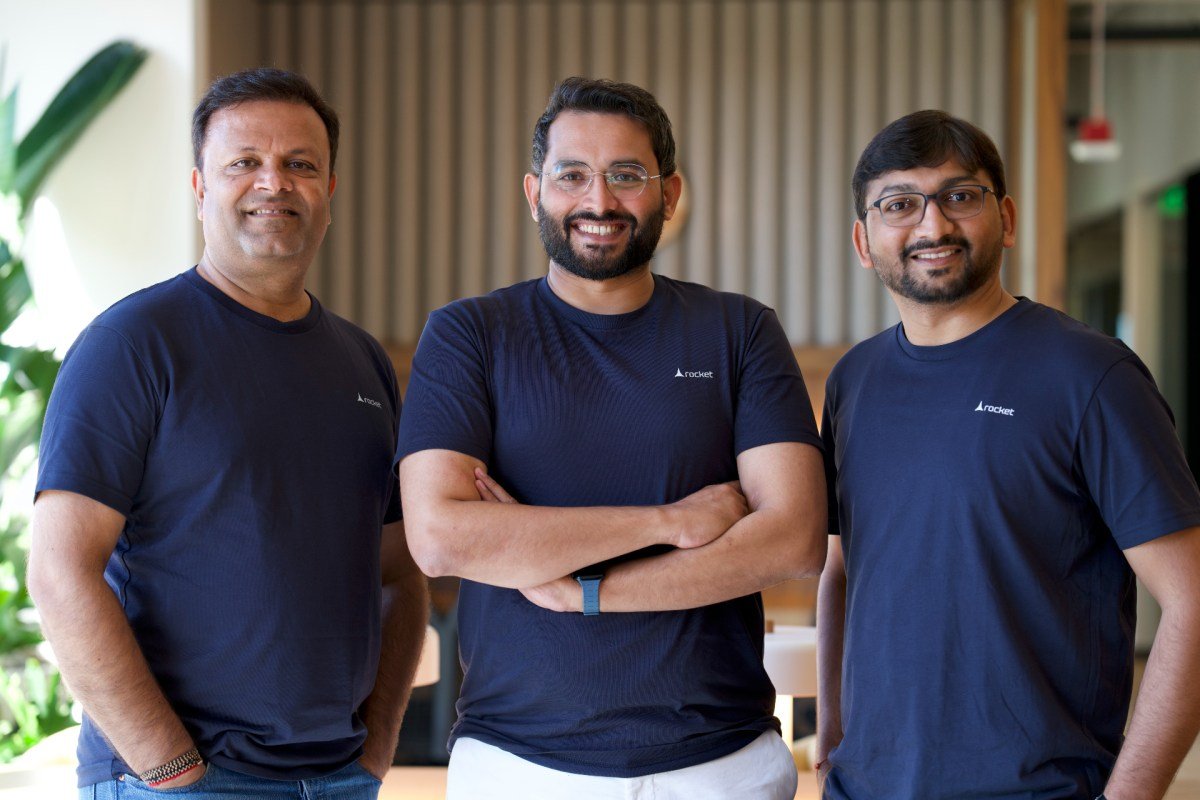
Since its debut, the startup has crossed 400,000 users — including over 10,000 paid subscribers — in 180 countries and reached $4.5 million in annual recurring revenue. It is aiming to scale that to $20–$25 million by year’s end and $60–$70 million by June next year, co-founder and CEO Vishal Virani (pictured above, center) said in an exclusive interview.
Based in Surat — a city famous for diamonds and textiles but far from India’s usual tech hubs — Virani teamed up with Rahul Shingala and Deepak Dhanak to launch Rocket.new. The startup marks a pivot from their earlier venture, DhiWise, which focused on developer workflows.
“We are building the first vibe solution platform, which is not solving just a problem of day one, but what we are focusing on is solving the problem of day two,” Virani told TechCrunch.
The 16-week-old startup aims to become a comprehensive agentic system, which will utilize AI not only to build apps and websites but also to conduct competitive research and product development, eliminating the need for product managers.
“Our entire agentic system will help organizations build all kinds of functions around products — not just generating the source code — but even a facility to scale their product — all by giving natural-language prompts,” Virani asserted.
Techcrunch event
San Francisco
|
October 27-29, 2025
The current model, which Virani refers to as version 0.3, has already built half a million applications and attracted product managers, solopreneurs, and front-end developers. It also counts users from companies like Meta, PayPal, KPMG, PwC, and Times Internet, who turn to the platform for personal projects.

About 80% of Rocket.new’s users have so far built what Virani calls “serious” applications rather than simple landing pages or branding sites. Roughly 12% have created e-commerce platforms in segments like grocery and apparel, 10% have built fintech apps, 5–6% have developed B2B tools, and 4–5% have launched mental health apps, he said.
Roughly 45% of Rocket.new’s users are building mobile apps and 55% are building websites, Virani said. He added that many users build a website on Lovable or Replit, then turn to Rocket.new to generate a native mobile app by integrating with their existing Supabase backend.
The platform combines large language models from Anthropic, OpenAI, and Google’s Gemini with Rocket.new’s own deep learning systems, which are trained on proprietary datasets from DhiWise.
“Our underlying architecture is completely different from what Lovable, Bolt, and everyone is doing,” Virani told TechCrunch.
Generating the first application takes about 25 minutes — much slower than most vibe-coding tools, which usually produce results within three. But in our early testing, Rocket.new delivered a more comprehensive user experience, with all essential modules included.
Rocket.new offers a free trial capped at one million tokens. After that, users pay a monthly subscription starting at $25 for five million tokens.
This model effectively discourages hobbyists, while giving Rocket.new a healthy gross margin of 50–55% — a figure it aims to raise to 60–70% within the next few months.
The U.S. is Rocket.new’s largest market, contributing 26% of revenue, followed by Europe at 15–20% and India at 10%. To better serve its American users, the startup is establishing a U.S. headquarters in Palo Alto.
Virani noted that Rocket.new’s early traction was organic, driven by word-of-mouth and viral social posts. With fresh seed funding, the startup is looking to sharpen its go-to-market playbook, deepen its presence in key markets, and accelerate work on proprietary models and R&D.
“We saw a clear gap between the magic of AI code generation and the reality of making that code production-ready,” Kartik Gupta, Investor at Salesforce Ventures, told TechCrunch over email. “Rocket.new is purpose-built to solve this problem of iteration, maintenance, and deployment at enterprise scale.”
Rocket.new currently has a 58-member team, primarily in Surat, and expects to double its engineering and product staff in India over the next 12 months to support growth.
